
Imagine you want to invest in learning AI capabilities, helping you to do the product management on a new level that these days market is demanding. How would you start?!
This blog helps you start your AI journey powerfully.
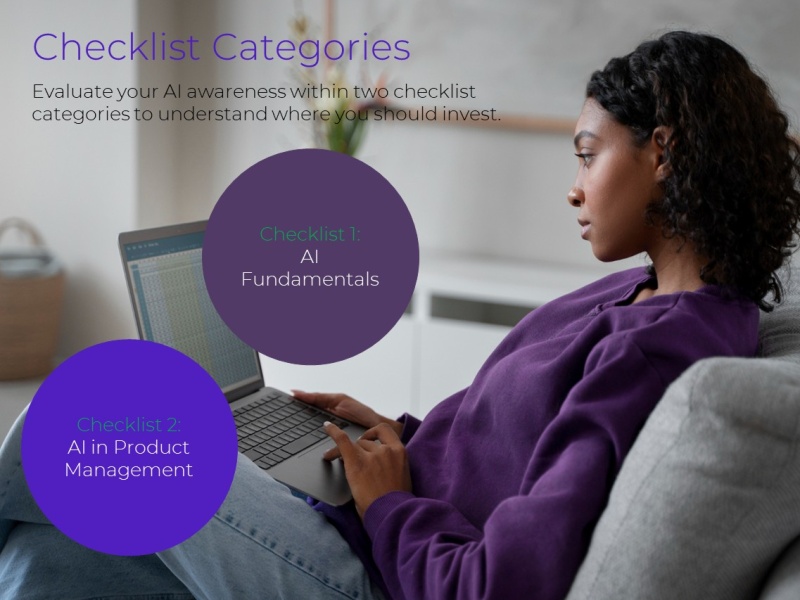
Your first step has two main checklist categories:
Checklist 1: AI Fundamentals
Checklist 2: AI in Product Management
Let's check them one by one.
Checklist 1: AI Fundamentals
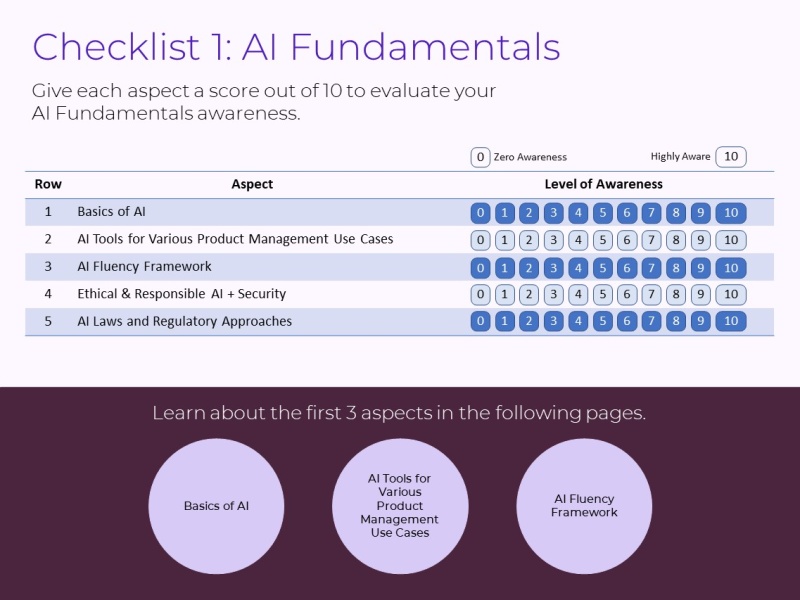
The first checklist has 5 items, including:
- Basics of AI
- AI Tools for Various Product Management Use Cases
- AI Fluency Framework
- Ethical & Responsible AI + Security
- AI Laws and Regulatory Approaches
Give each aspect a score out of 10 to evaluate your AI Fundamentals awareness.
Let's talk about the first 3 aspects.
Basics of AI
Here are 20 key basic terms of AI that you should know:
1- AI (Artificial Intelligence)
Artificial Intelligence, or AI, is a technology that enables computers to simulate human intelligence and problem-solving capabilities.
Examples are Siri or reading a car's plate number at the parking entrance.
2- Generative AI
Generative AI refers to artificial intelligence models that can create new content, such as text, images, audio, or video.
Examples are ChatGPT or DeepSeek.
3- ANI (Artificial Narrow Intelligence)
Artificial Narrow Intelligence, or ANI, is a type of AI designed to perform a single specific task.
Examples are self-driving cars or defect detection in a factory line
4- AGI (Artificial General Intelligence)
Artificial General Intelligence, or AGI, is the potential form of AI that can perform any intellectual task a human can.
5- Agentic AI
Agentic AI refers to AI systems designed to autonomously make decisions, plan, and execute tasks to achieve goals with minimal human intervention.
6- AI Model
A model is an AI system that has been trained on a dataset to recognize patterns, make predictions, or generate new content.
Examples are GPT-4 model by OpenAI or Gemini 1.5 Flash model by Google.
7- Algorithm
An algorithm is a set of rules or instructions designed to enable machines to learn from data, make decisions, or perform tasks.
8- LLM (Large Language Model)
Large Language Model, or LLM, is a type of AI trained on vast amounts of text data to understand and generate human-like language.
9- Multimodal
Multimodal describes models that can process and generate multiple types of data, like text, images, audio, and video.
An example is Gemini 1.5 by Google that can process and generate text, images, audio, video, and code.
10- ML (Machine Learning)
Machine Learning is a subset of AI that enables systems to learn from data, identify patterns and make decisions or predictions.
11- DL (Deep Learning)
Deep Learning is a subset of machine learning that uses multi-layered neural networks to learn complex patterns and create highly accurate outputs.
12- Prompt
A prompt is a text input given to an AI model to guide its response or generate desired output.
An example is: Write an email to stakeholders, inform them of the scope and goal of the Sprint, and invite them to the upcoming Sprint Review.
13- Prompt Engineering
The process of designing effective prompts to generate better and desired responses.
14- Supervised Learning
Supervised Learning is a model training approach to learn from paired input-output labeled data to predict outputs for new, unseen inputs.
15- Unsupervised Learning
Unsupervised Learning is a model training approach where a model discovers patterns and structures within unlabeled data.
16- Reinforcement Learning
Reinforcement Learning is a model training approach where a model learns to optimize decisions based on receiving rewards and penalties for actions.
An example is when computers learn to play chess.
17- Diffusion Model
A diffusion model is a generative AI technique that learns by iteratively adding noise to data and then denoise it to create new outputs like images.
An example is that most AI images are generated by Diffusion Models.
18- RAG (Retrieval-Augmented Generation)
Retrieval-Augmented Generation, or RAG, is an AI technique that enhances large language models by retrieving information from external sources to generate more accurate and context-aware responses.
An example is giving your company's HR policy document to a model, then your employees can ask how to use the company parking lots or how to have a work mobile phone.
19- Fine-tuning
Fine-tuning is the further training of a pre-trained AI model on a smaller, domain-specific dataset to enhance its performance for a particular domain.
Examples are fine-tuning a model for medical or legal domains.
20- Token
A token is the fundamental unit of text that an AI model processes, which can be a word, part of a word, or even a single character.
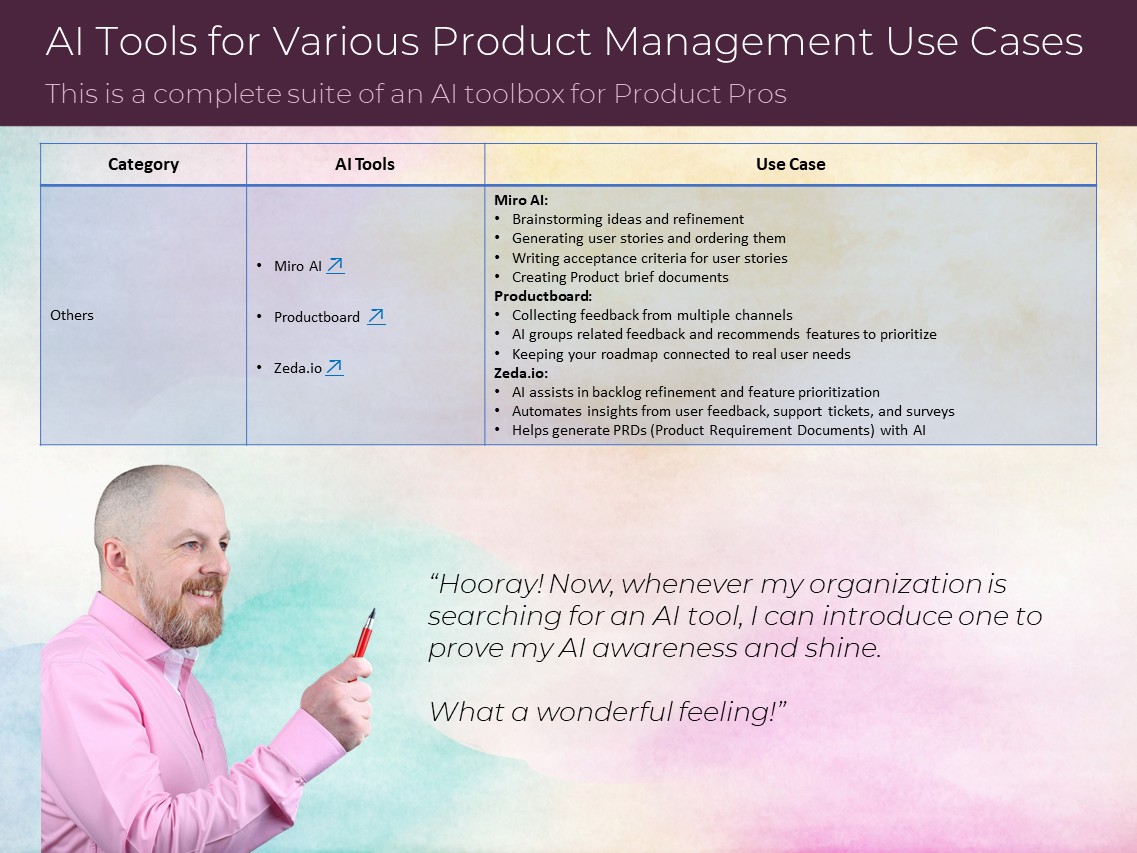
AI Tools for Various Product Management Use Cases
This is a complete suite of an AI toolbox for Product Pros:


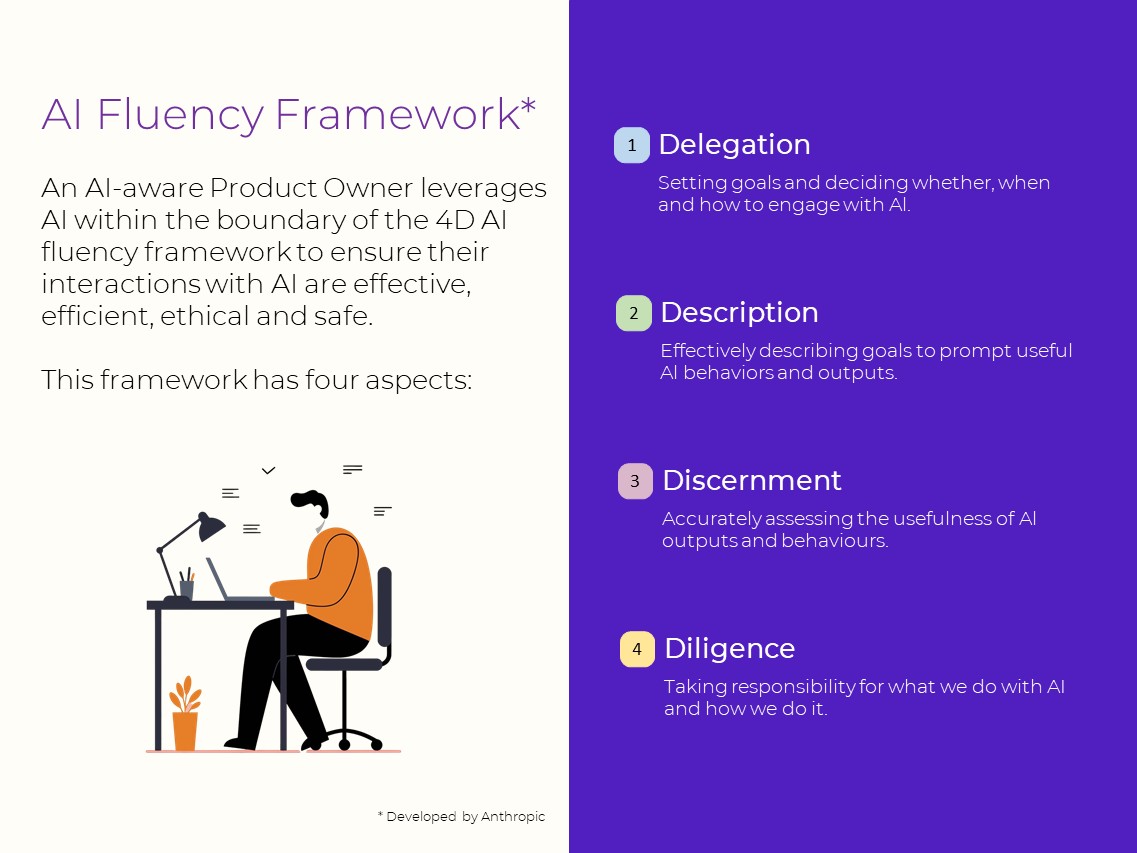
AI Fluency Framework
An AI-aware Product Owner leverages AI within the boundary of the 4D AI fluency framework to ensure their interactions with AI are effective, efficient, ethical and safe.
This framework has four aspects:
1- Delegation
Setting goals and deciding whether, when and how to engage with Al.
2- Description
Effectively describing goals to prompt useful Al behaviors and outputs.
3- Discernment
Accurately assessing the usefulness of Al outputs and behaviours.
4- Diligence
Taking responsibility for what we do with AI and how we do it.
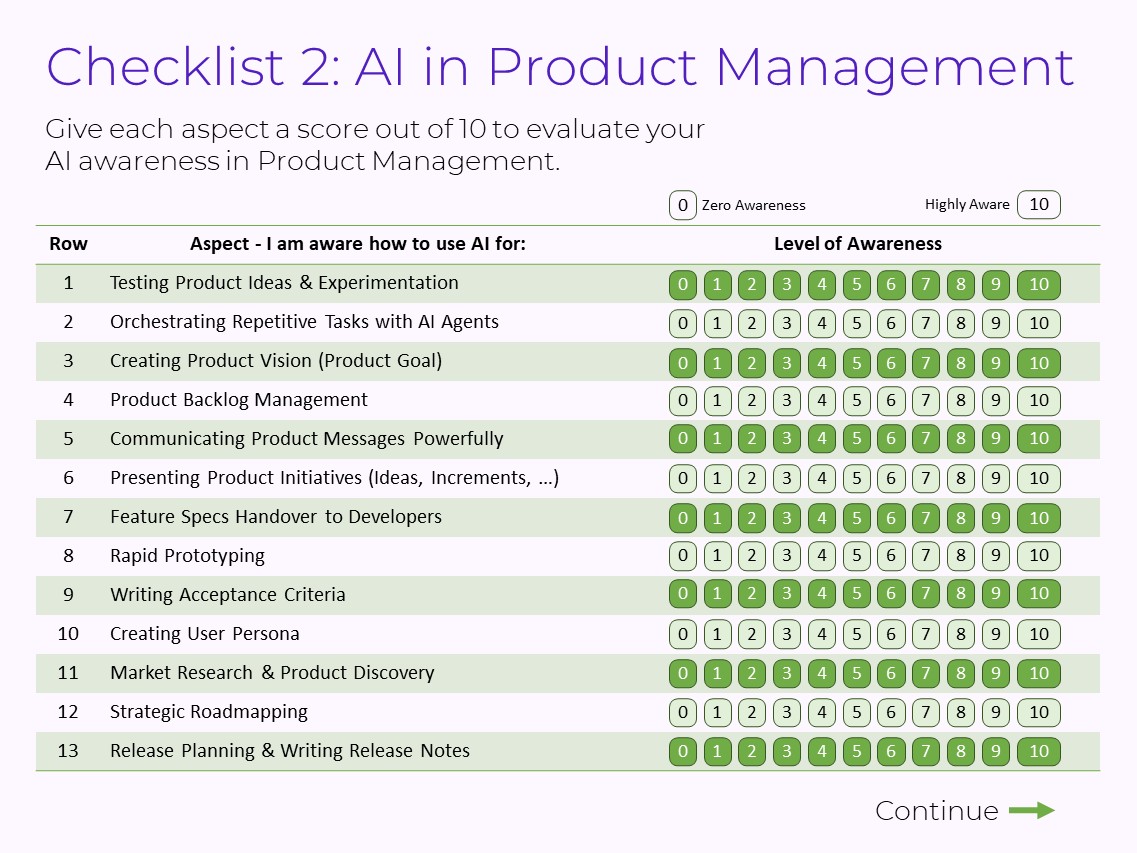
Checklist 2: AI in Product Management
The second checklist has 20 items, including:
- Testing Product Ideas & Experimentation
- Orchestrating Repetitive Tasks with AI Agents
- Creating Product Vision (Product Goal)
- Product Backlog Management
- Communicating Product Messages Powerfully
- Presenting Product Initiatives (Ideas, Increments, …)
- Feature Specs Handover to Developers
- Rapid Prototyping
- Writing Acceptance Criteria
- Creating User Persona
- Market Research & Product Discovery
- Strategic Roadmapping
- Release Planning & Writing Release Notes
- Facilitating Product-related Meetings
- Stakeholder Management
- Customer Understanding
- Feedback Management
- Designing & Tracking Product Metrics
- Product Data Analysis & Insights
- Storytelling
Give each aspect a score out of 10 to evaluate your AI awareness in Product Management.
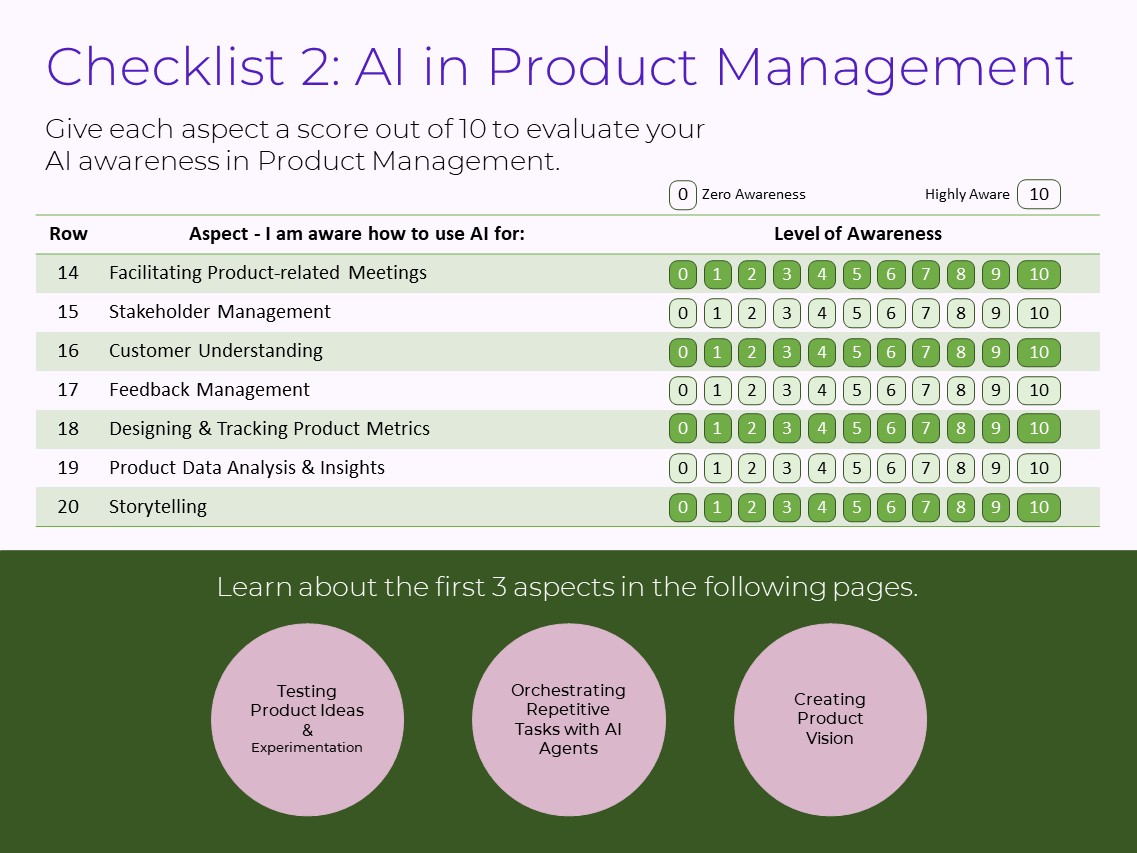
Let's talk about the first 3 aspects.
Testing Product Ideas & Experimentation
Imagine a big Italian pizza restaurant orders your team to build a new website to sell pizza online. Instead of having hours of conversation, you can use AI to rapidly create a visualization of what you have in mind to get feedback from your customer. Once you are on the same page, then you can ask developers to implement it.
Visily is an AI tool to help non-designers rapidly turn product ideas into polished visual designs.

You can use Visily AI for:
- Brainstorming
- Wireframing
- Mockup creation
- Prototyping
Prompt for the pizza restaurant:
"Create a website for an Italian restaurant that just cooks original pizza with a homepage, menu, reservation form, and contact. Use a modern olive green color palette."
See the result in this image:

Orchestrating Repetitive Tasks with AI Agents
AI Agent is an autonomous software system that uses artificial intelligence to perceive its environment, make decisions, and take action to achieve a specific goal without constant human intervention.
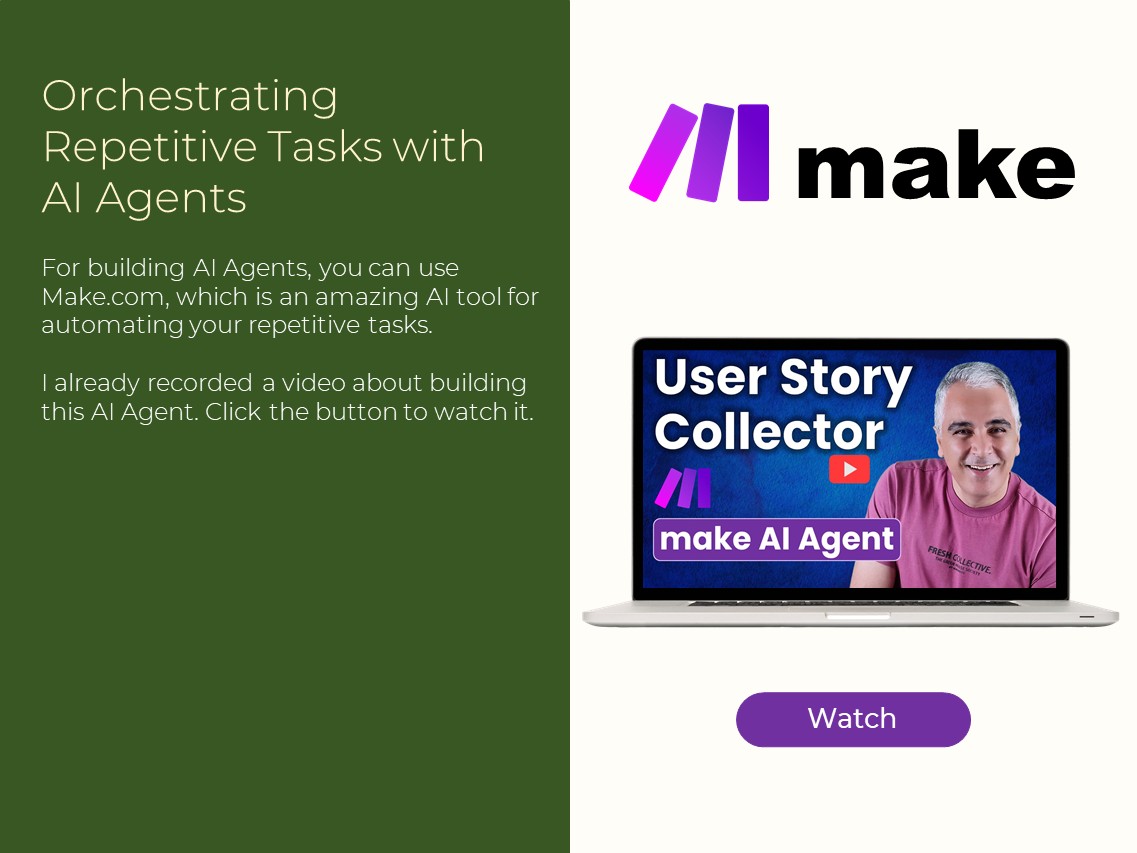
Imagine you receive dozens of customer support tickets each day. Your email provider is Outlook. Customers may sometimes request new features. Now, you want to set up an AI Agent to monitor incoming emails. If it discovers a new feature, add it to your Product Backlog, which is in Trello.
We call this AI Agent: User Story Collector. It can free up a lot of your time to use it for strategic work.
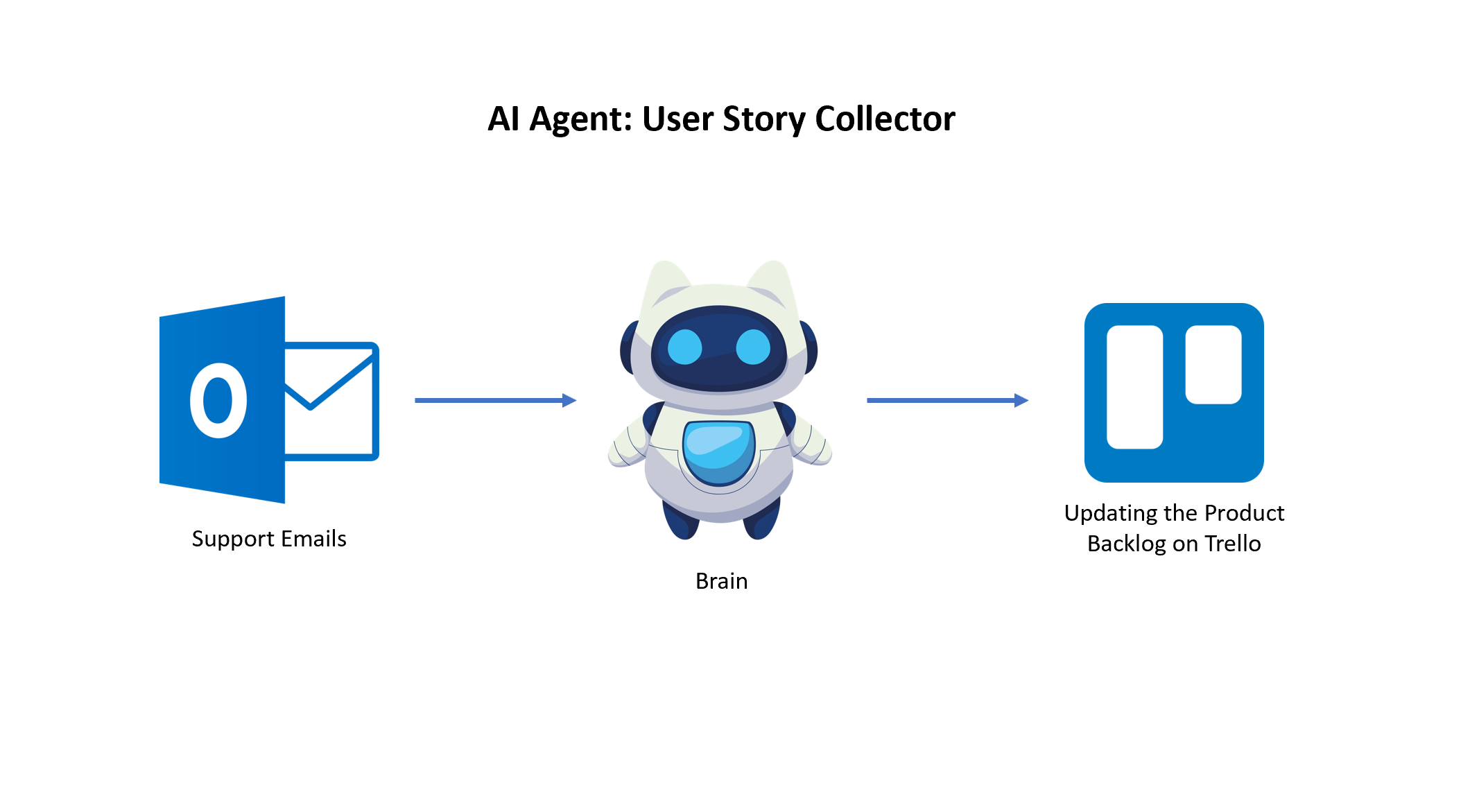
For building AI Agents, you can use Make.com, which is an amazing AI tool for automating your repetitive tasks.
I already recorded a video about building this AI Agent. Click here to watch it.
Creating Product Vision
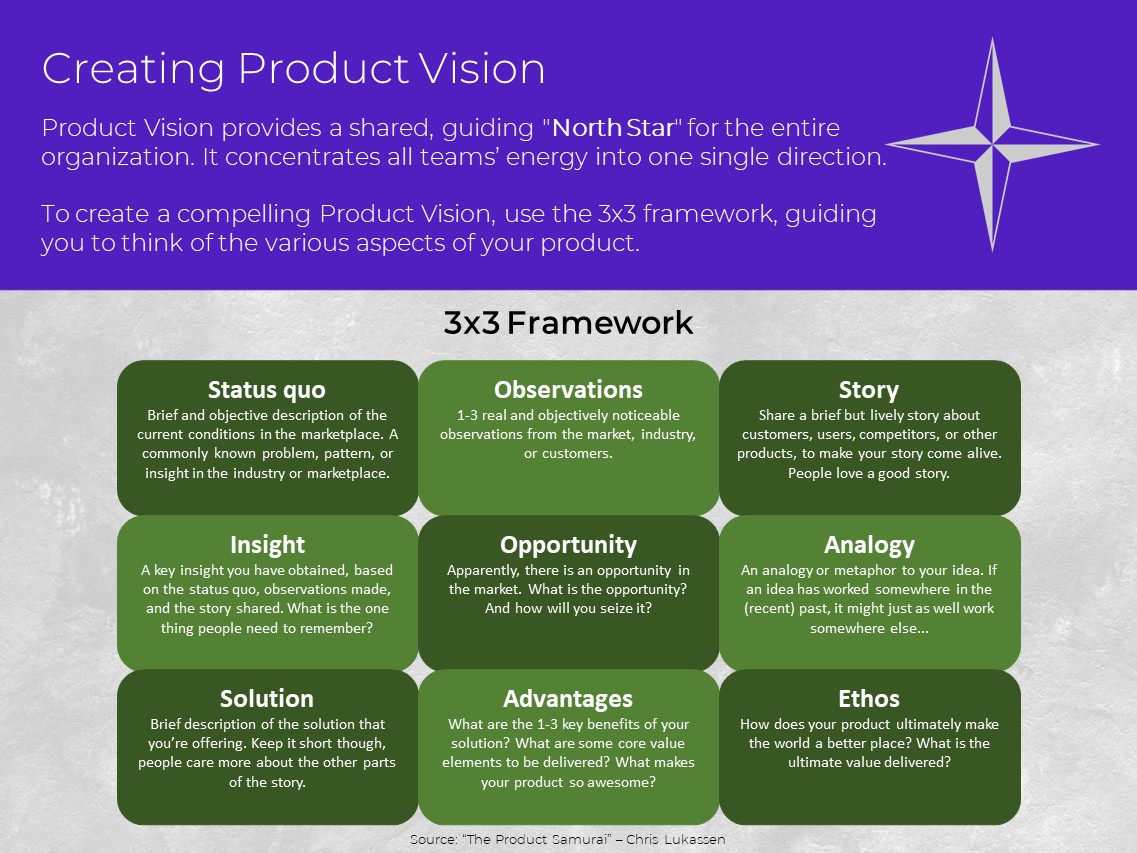
Product Vision provides a shared, guiding "North Star" for the entire organization. It concentrates all teams’ energy into one single direction.
To create a compelling Product Vision, use the 3x3 framework, guiding you to think of the various aspects of your product.
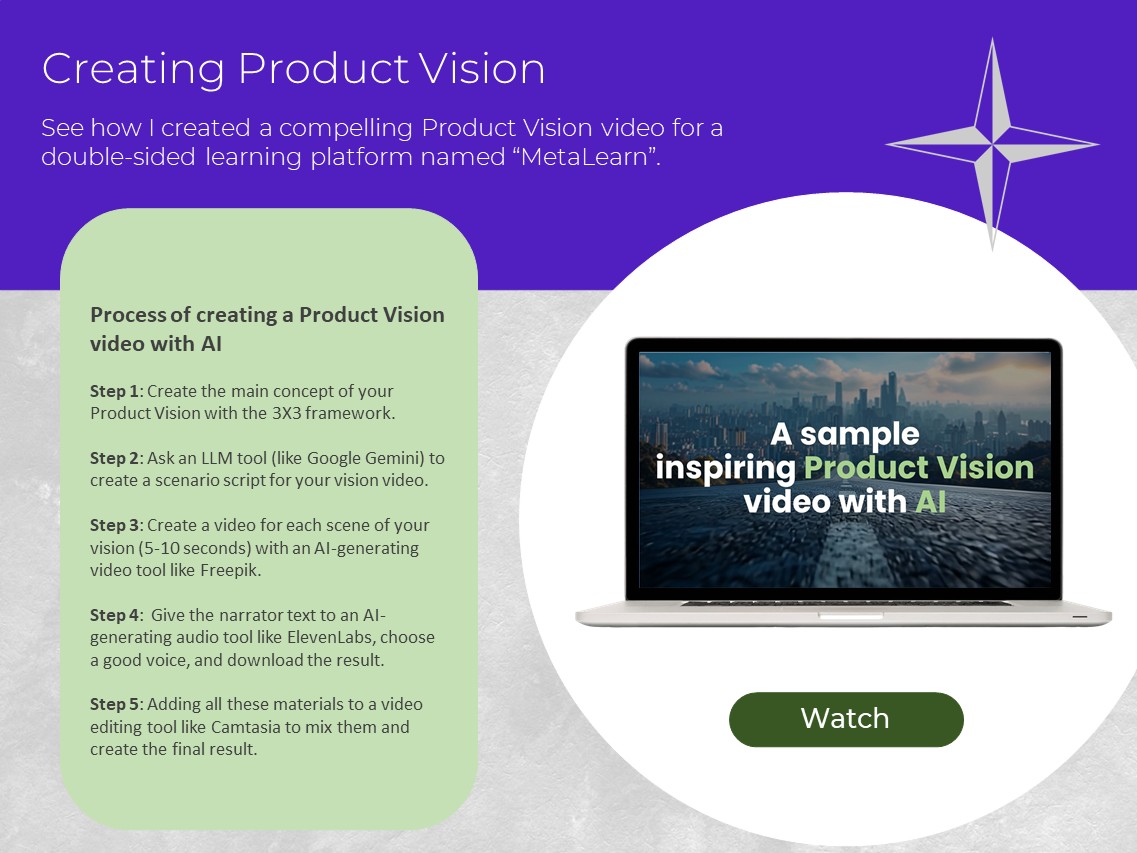
See how I created a compelling Product Vision video for a double-sided learning platform named “MetaLearn”. Click here to watch the video.
Process of creating a Product Vision video with AI
Step 1: Create the main concept of your Product Vision with the 3X3 framework.
Step 2: Ask an LLM tool (like Google Gemini) to create a scenario script for your vision video.
Step 3: Create a video for each scene of your vision (5-10 seconds) with an AI-generating video tool like Freepik.
Step 4: Give the narrator text to an AI-generating audio tool like ElevenLabs, choose a good voice, and download the result.
Step 5: Adding all these materials to a video editing tool like Camtasia to mix them and create the final result.
Now you have everything you need to start your AI journey. Good Luck!