
Two weeks ago, I described how 92% of product leaders now own revenue outcomes—but lack the authority to deliver them. Last week, I showed how AI accidentally solved one of four structural gaps by democratizing data access. Now we face the uncomfortable truth: AI is forcing organizations to redesign decision rights, governance, and funding—not because executives suddenly care about Product Owners, but because AI won't work without these changes.
The gap between accountability and authority isn't closing because organizations finally "get it." It's closing because operating at AI speed requires the same structural changes Product Owners have needed for years.
The Three-Speed Problem
In October, I wrote about the deadly incompatibility between three organizational speeds: AI speed (continuous learning that compounds daily), adaptation speed (Agile approaches matching AI's iterative pace), and organizational speed (systemic change with aligned incentives and distributed authority).
When these speeds are incompatible, 46% of AI pilots fail. Organizations can't layer machine-speed execution onto human-speed governance and expect results. The forcing function isn't optional—synchronize all three speeds or watch your AI investment decay.
Here's what makes this relevant to Product Ownership: closing the speed gap requires exactly the structural changes Product Owners need to exercise evidence-based authority. Same problem, same solution, different trigger.
Gap #1: Decision Rights → Distributed Accountability
Traditional organizational design uses hierarchical delegation. Decisions flow through org charts. Product Owners request authority, wait for approval, coordinate across functions, and hope the business approves their roadmap.
AI-native operating models replace org charts with work charts—networks of accountability organized around outcomes, not reporting lines. When 2-5 humans supervise 50-100 AI agents, you can't wait three weeks for approval. Execution happens at machine speed. Authority must be distributed to where the work happens.
This isn't delegation; it's distributed accountability. Product Owners gain authority to direct outcomes because the alternative—coordinating agent workflows through traditional hierarchies—is operationally impossible.
The irony: Organizations are redesigning decision rights to enable AI agents. Product Owners inherit the same authority by necessity.
Gap #2: Governance → Adaptive Governance Cycles
Traditional governance operates in quarterly cycles with point-in-time audits. Policies are static documents reviewed annually. Compliance happens after the fact.
AI-native governance shifts from academic to practical—continuous monitoring, embedded controls, policies as living assets. When AI agents iterate daily, governance must match that pace. Automated drift detection triggers human intervention only when needed. Guardrails operate in real-time, not retrospectively.
For Product Owners, this transformation is structural gold. Evidence-based Product Ownership requires continuous validation, not quarterly reviews. The same adaptive governance cycles enabling AI agents also enable Product Owners to make data-informed decisions validated continuously against outcomes.
Governance stops being a gate and becomes a feedback loop. Product Owners gain the authority to act because their decisions are monitored continuously rather than audited quarterly.
Gap #3: Funding → Continuous Value Stream Funding
Traditional funding is project-based. Teams form, deliver, disband. Budgets restart each cycle. Knowledge scatters.
AI compounds learning. Restarting teams destroys the intelligence agents have built. 77% of organizations now use AI-native development, which requires persistent teams and continuous value stream funding. Lean portfolio management allocates budgets to outcomes, not projects. Teams persist. Learning compounds.
Product Owners have argued for persistent teams for years. The business case was "better collaboration." The AI case is "preserving intelligence." Guess which argument wins budget approval.
The result: Product Owners finally get teams that stay together, budgets that flow to outcomes, and the stability required to build compounding product knowledge.
The Evolution: Product Operating Model → Agentic Organization
For 15 years, I've helped organizations adopt Product Operating Models—frameworks that position Product Owners as central decision-makers empowered by cross-functional teams, continuous discovery, and outcome-based accountability.
The agentic organization isn't a replacement. It's evolution. Where Product Operating Models put humans at the center of decision-making, agentic organizations position humans above the loop—steering strategic direction while AI executes at speed.
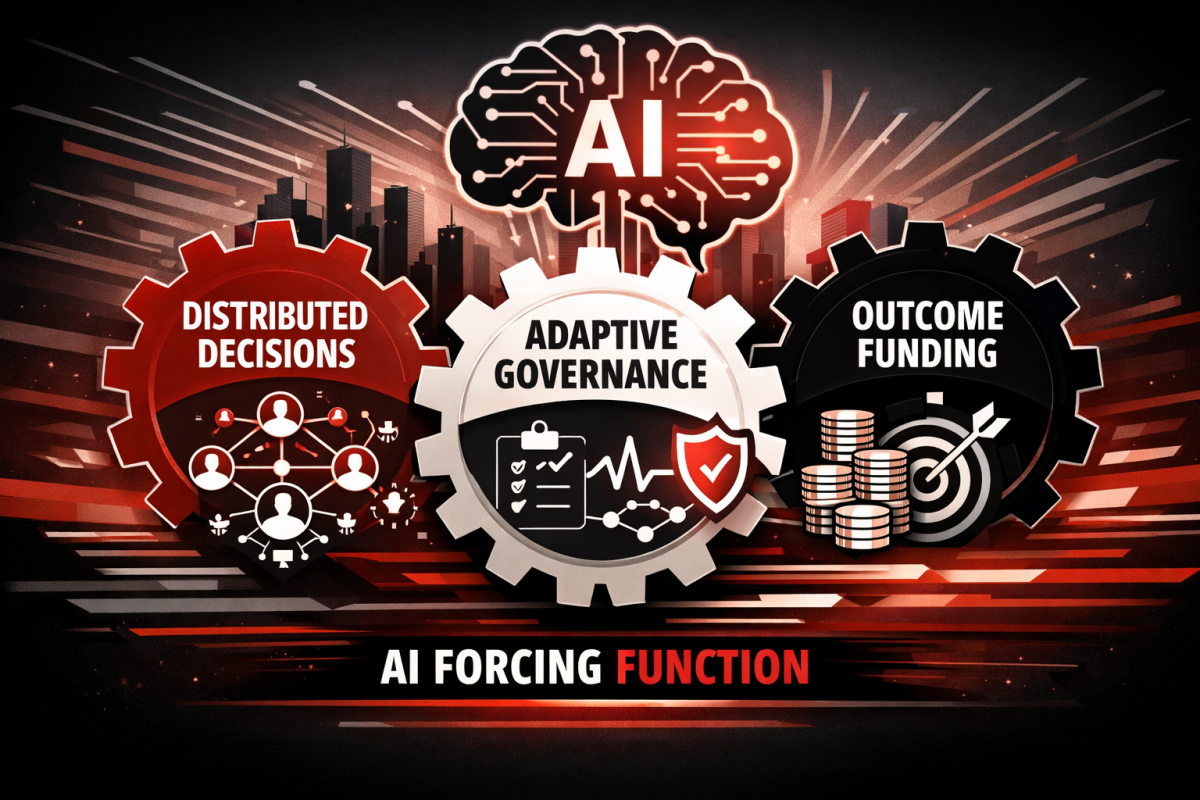
Decision rights shift from hierarchical to distributed because you can't coordinate 100 agents through traditional approvals. Governance shifts from quarterly to continuous because AI iterates daily. Funding shifts from project-based to value-stream because AI compounds learning.
Product Owners don't need to lobby for these changes. AI requires them.
The Reality Check: Only 16% Are True Agents
Before this sounds too utopian, understand the gap between aspiration and reality. Most "agentic AI" deployments are fixed-sequence workflows, not true agents. Only 16% qualify as autonomous systems that pursue goals, adapt strategies, and coordinate without human orchestration.
For many organizations, the agentic organization remains aspirational. But the direction is clear. Organizations adopting AI at scale face the three-speed problem whether they have true agents or sophisticated workflows. The structural changes—distributed decision rights, adaptive governance, continuous funding—become necessary regardless.
Product Owners benefit either way. The same forces requiring empowered decisions for AI workflows also require empowered Product Owners.
What This Means for Product Owners
Let's complete the trilogy:
The problem: Four structural gaps between accountability and authority—decision rights, governance, funding, measurement.
The catalyst: AI accidentally democratized data access, solving gap #4 and making evidence-based Product Ownership possible.
The transformation: AI-native operating models are redesigning organizations to operate at machine speed, structurally solving gaps #1-3 and making empowered Product Ownership necessary.
The same distributed decision rights AI requires empower Product Owners to direct outcomes. The same adaptive governance AI needs enables evidence-based Product Ownership. The same continuous funding AI demands supports persistent product teams.
AI didn't solve the authority gap because anyone cared about Product Ownership. AI solved it because organizations can't operate at machine speed with human-era structures.
The Forcing Function
The three-speed problem isn't just a risk—it's a forcing function. Organizations either synchronize AI speed, adaptation speed, and organizational speed, or they fail. Synchronizing requires distributed authority, adaptive governance, and continuous funding.
Product Owners finally get the authority their accountability demands—not through persuasion, but through structural necessity.
After 15 years helping organizations build Product Operating Models, I can say this: the agentic organization isn't replacing what we've built. It's proving why it matters. When execution happens at machine speed but strategic direction remains human, Product Owners become the critical link between business intent and operational reality.
The authority gap is closing. Not because organizations evolved their thinking, but because AI forced their structure.
Ralph Jocham is Europe’s first Professional Scrum Trainer, co-author of “Professional Product Owner,” and contributor to the Scrum Guide Expansion Pack. As an ICF ACC certified coach, works with organizations to build Product Operating Models where strategic clarity, operational excellence, and adaptive learning create measurable competitive advantage. Learn more at effective agile.