
What makes a Sprint valuable?
If at the end of the Sprint, the Scrum Team is able to meet the goal and stakeholders, users expectations. A Sprint is not just about delivering functionality, it is an opportunity to experiment and validate assumptions about what Value is being created or delivered.
Yet, how often have you observed that neither of the aforementioned statements are true and Scrum Teams are stuck in an unengaging cycle converting business requirements into software deliverables which do not create any real value.
Ever thought why does that happen and as a Scrum Master how can you make it better? The answer is pretty easy to guess. It all boils down to Sprint Planning. If the Sprint Planning is not effective then often, the results do not add up.

Here are my simple 3 tips to improve your Sprint Planning.
Tip#1 Clarity of Goals
As a young student I was told a quote, “A ship without the rudder is directionless, aimless and at the mercy of elements”. This quote has resonated with me for long and it metaphorically highlights that if one doesn’t have a clear goal or objective, then that person may drift aimlessly. This is true for Sprints and Scrum Teams too. If a clear unifying goal is not established then typically the Sprint would seem incoherent and Scrum Team members would work in silos without taking collective ownership of delivery. Often, without a unifying shared goal Developers get quickly disengaged at work.
Without a goal, people also tend to shy away from responsibility. I have heard coders say coding is done, testing is up to the testers if they didn’t do their work, how can we be responsible for it. Similarly, testers used to call out, coders give code at last minute so testers are stretched and often defects are missed and end up in production.
Clarity of goals provides a shared understanding and sense of connect. It also drives a sense of collective ownership because now everyone contributes to achieve the same common goal. Scrum has embedded Product Goal and Sprint Goal which can help Scrum Teams to drive clear focus.
At Sprint Planning, the Product Owner can clarify the Product Goal - long term objective - and highlight which PBIs can help achieve it. During the Sprint Planning, the whole Scrum Team can then collaborate to draft a Sprint Goal - a business oriented objective for the Sprint - that moves them closer to the Product Goal.
Remember to keep the Sprint Goal business focused and not something about completing ‘X’ number for features/tasks by end of sprint.
An example of a good Sprint Goal can be -
Improve the trust of users by fortifying the authentication mechanism
instead of stating
Complete the login authentication form using SSO and Two-factor authentication.
Tip#2 Capacity Allocation
I assume that most of us have seen or read the famous story from Stephen Covey or its adaptation about the big rocks and small rocks where a professor demonstrates to students how it is required to give importance to the most valuable aspects of life like family and friends.
If not here’s how it goes -
A teacher shows her students an empty glass jar and asks if it is full? To which everyone disagrees. Then she picks a few big sized rocks and puts them in the jar and asks if it is full? To this the students say Yes! Now the teacher picks a handful of pebbles and adds it to the jar and asks again if the jar is full. To which the students hesitate a bit but say Yes. And then she puts sand into the jar, “Is the jar full?” comes a rhetorical question to which now the students learning from their experience say “No”. Then the teacher pours a cup of coffee and states now the jar is full. And asks - What is the lesson? She also concludes after hearing the students' answers that the real lesson is - if one doesn’t put the big rocks first, they will never fit.
Now, how does this help us in Sprint Planning? Well we need to find the big rocks first that would take our capacity. So what are these big rocks? At Sprint Planning, we establish a Sprint Goal, the Product Backlog Items that support the Sprint Goal are the big rocks.
The second important thing about capacity allocation is to define - how much capacity do we have available for the Sprint? In my experience, I have seen teams doing a 80:20 ratio; 80% business functionality and 20% everything else. I believe that doesn’t really give a clear picture. I would personally prefer to do capacity allocation as depicted in the following image.
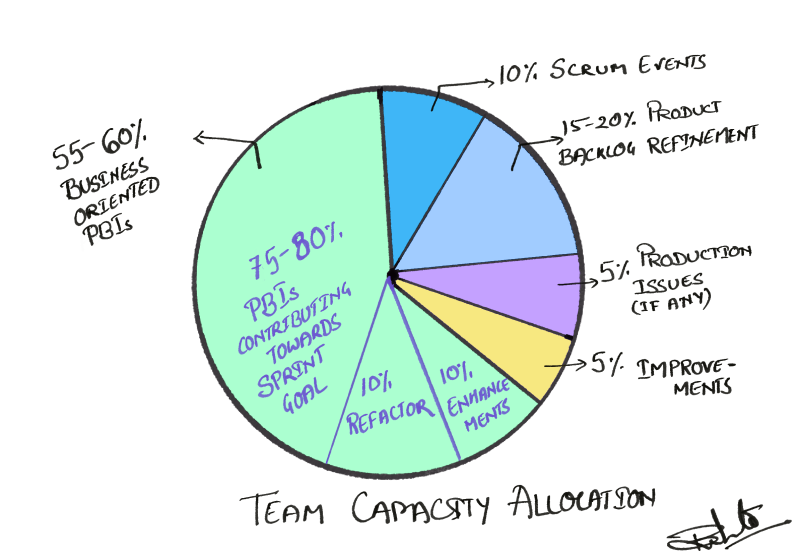
This brings more transparency and clarity to how the team's capacity is being used to create value.
Tip#3 Product Backlog Refinement
If the requirements to be worked upon are viewed for the first time at the Sprint Planning then they will be full of surprises. Often, this would mean a lot of back & forth discussions that may or may not lead to an effective plan.
For Sprint Planning to have lesser surprises and be more efficient, effective Product Backlog Refinement is the key. Product Backlog Refinement is where Developers can:
- Clarify any of their doubts and get a better understanding of the requirements
- Add or refine the Acceptance Criteria for the PBIs
- Break down the larger PBIs into logical, valuable, granular chunks of work that can be easily done within the Sprint.
- Product Backlog Refinement creates a shared understanding of what needs to be done and leaves less space for error.
Effective Product Backlog refinement leads to a focused Sprint Planning session where decisions about Value are made instead of paying attention to how many story points to be assigned to a PBI.
Conclusion:
Sprint Planning is a collaborative event between the Product Owner and Developers; where the Product Owner creates alignment through Product Goal while the Developers try to identify what is possible given the constraints. Having an effective Sprint Planning which enables a focused Sprint Goal and a relevant Sprint Backlog, is necessary to execute a Sprint that delivers customer outcomes and not just finished work items.
P.S. In case you are exploring to learn more about professional scrum or looking for mentorship then please visit www.agilemania.com