
Has it ever happened on your Scrum Team, that you get into a Sprint Planning session and by the end of it, it still feels that there is no plan for the Sprint? Or probably as Developers you think that there is too much to do at this Sprint or probably you don’t understand how all different work items are connected? Maybe as a Product Owner you think - looks like the team hasn’t got the grasp of what needs to be done. If all this sounds similar, then it is very possible that your Sprint Planning events are often not very effective. And somewhere the responsibility of making the Sprint Planning effective falls largely on the shoulders of the Product Owner.
Here is how as a Product Owner you can make the Sprint Planning effective. I call this approach presenting your CASE.
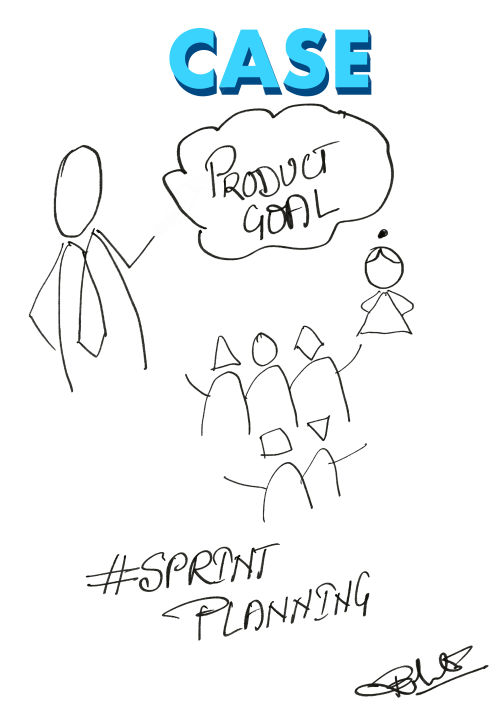
Clarify the intent
As a Product Owner, the most important thing one has to do is to establish a clear intent for the Sprint Planning.
Many times (in my experience) the Product Owner walks into the Sprint Planning with a bunch of disconnected work items and asks the Scrum Team to plan the sprint with the same work items. This creates disconnect and leads to developers working in silos without any unifying objective. Also, since there is no clear objective people often tend to be disengaged at work.
The Product Owner’s job at the Sprint Planning is to provide a clear intent, a direction for the Scrum Team to work cohesively and collaboratively. This can easily be achieved by communicating and clarifying the Product Goal. The Product Goal sets the tone for the Sprint Planning and it also acts as an unifying glue between multiple sprints.
Agree on the options
The next thing to do for the Product Owner at Sprint Planning is to highlight the Product Backlog Items that can eventually deliver the expected value and take the team closer to the Product Goal.
As a Product Owner, clearly establish what actual value each work item can bring to the product and how this work item aligns to the Product Goal.
Also, be aware that not always every work item presented by you at the Sprint Planning might be possible given the constraints of the team. In such scenarios, provide, discuss and agree on best possible options to move forward.
Satisfy Curiosity
Developers are creative folks. They think and hence they will always have questions. At Sprint Planning as a Product Owner ensure that you are able to clarify their doubts, provide reasonable answers to their questions.
Sprint Planning is a collaborative process to create a shared understanding of what needs to be done, why it is important and how it will be done. The HOW part can’t be successfully achieved if assumptions linger around on the WHY and WHAT aspects of the planning process.
One note of caution though, avoid getting into the rabbit hole during conversations. If you believe that conversations are digressing from the main purpose, park the requirement and come back to it a little later. If there are too many digressing conversations around a particular Product Backlog Item, there are high chances that even if you plan it, it might not get DONE.
Empower Negotiation
Customer Collaboration over Contract Negotiation is an important value when it comes to agile ways of working. Sprint Planning enables this collaboration. As a Product Owner one has to work with Developers to find out what is feasible within the Sprint given the constraints with which the team is working.
Support the team when they negotiate on the scope of work because ultimately they are the folks who will get the work done and can forecast how much is possible. Don’t push “scope of work” on to the team. Always remember, as a Product Owner for you the most important aspect is to “maximize value for the product”; delivering more functionality does not guarantee more value. So, listen to the team, set the goal and negotiate on the scope.
And if you can present your CASE in the right way next time, you would find your Sprint Planning more effective and valuable.
Conclusion:
Sprint Planning is an Inspect-Adapt opportunity for the whole Scrum Team. However, whether it turns out to be effective or not, largely depends on how well the Product Owner is prepared. This is because the Product Owner is the value optimizer and if the Product Owner can’t establish what creates value then all the work done during the Sprint might turn out to be incoherent and useless.
p.s. If you want to explore more about professional product ownership then join our #mentoring program or explore the resources available at our website.
You might also want to explore my youtube channel and available #pspo courses that I often teach.