
Scrum mastery is almost like flying.
Just like flying, it requires laws (principles), checklists (routines), co-pilots (colleagues), and air traffic controllers (mentors) to help you take off and land—otherwise, things get dangerous. With one exception: unlike pilot training, the path to becoming a Scrum Master is still in its infancy. You can’t get a degree in Scrum Mastery, and formal, comprehensive education is hard to find.
Over the last ten years, I’ve built my toolkit piece by piece (and I’m still working on it) — often through hard work, sometimes by chance, and mostly through trial and error. Looking back, I wish I’d had someone to show me early on what actually matters.
That’s why I’m writing this article for you, if you’re thinking about truly mastering Scrum.
Let’s start with the most important step.
Step #1: Work for a company that actually delivers software.
"Do you have to master something to teach it?"
There is a lot of debate around this question. Some point to professors who only teach what they have researched themselves. Others argue that the best soccer coaches were rarely world-class players. Personally, I side with the "Professor Camp" — at least when it comes to Scrum.
It wasn't until I saw with my own eyes how a team delivered software at the push of a button that I truly understood what is possible with Scrum. The most defining moment: A developer implemented customer feedback, pushed the change live, and the customer tested it right then and there. All of this happened during the Sprint Review! From that day on, I realized: Scrum is a tool for risk mitigation and true predictability only exists where delivery is possible at any time.
Which is the primary promise of every agile transformation.
When you want to master Scrum, you have to have experienced this at least once—otherwise, you can’t promise it, can you? You need to have seen how a team reacts to change and uses it to their advantage. You don’t necessarily need a "Scrum Team" for this. What matters is that you work in an environment where software is delivered regularly.
Step #2: Observe and learn from an experienced Scrum Master.
Scrum mastery isn't an art; it’s a craft.
And if you’ve followed Step #1, you should surround yourself with teams that can deliver software. Now, it’s time to learn. Learning any skill begins with observation.
Here are some questions you can ask yourself:
Observe the teams...
- ...and how they handle unclear requirements: Are they refined together or simply accepted?
- ...and which technical practices they use to deliver regularly: Is testing and integration automated?
- ...and how decisions are made and how the team handles disagreements: Are there clear principles, or is there constant friction?
Observe Scrum Masters...
- ...and how they build trust and connection: Is there active listening and transparency?
- ...and when they provide solutions versus when they create space for others to find them: Who takes responsibility?
- ...and how the team's focus is guided in delicate situations: Are conflicts avoided or addressed?
Observe Product Owners...
- ...and how they deal with scarce resources: Do they prioritize, or do they try to do everything at once?
- ...and how economic opportunities and risks influence decisions: Are assumptions made explicit and verified?
- ...and how the benefit of individual Product Backlog items is weighed against the effort: Are there conversations about "value" and not just "deadlines"?
Being successful as a Scrum Master means acting at the intersection of technology, business viability, and group dynamics.
If you want to become a successful Scrum Master, start by learning from others. It begins with observation — just like any other craft.
Step #3: Start your Scrum Mastery "on the side" first.
When I’m asked how to become a Scrum Master, I actually advise people against it at first.
Many people at the start of their careers can’t yet estimate how difficult this role really is. What they don’t see (yet): Scrum Masters don’t work directly on value creation. Therefore, they are constantly under scrutiny and have to face questions like:
- What is actually your contribution?
- What value does your work have for the company?
- And if you weren't there anymore—what would actually be missing?
For developers, these questions rarely come up. Every piece of code can potentially be sold or billed directly. But with process improvements, the added value isn't as obvious:
- How exactly do modern development methods increase efficiency?
- To what extent do regular Retrospectives improve team performance?
- And how does it help the company if the Product Owner finally talks to customers?
Don't get me wrong: All these activities can be translated into Euros — just not at first glance. That’s why I recommend to anyone thinking about becoming a Scrum Master:
Try it out first.
Here is my suggestion:
- Choose a typical Scrum Master accountability, e.g., "Accountable for the team's effectiveness."
- Find a team that accepts your support, for example, for a Retrospective.
- Facilitate that Retrospective.
Reflect afterward:
- What changed for the team because of my guidance?
- How can I see the success of my work for the company?
- And most importantly: Did I enjoy this work?
Empirical work — which is the heart of Scrum — means experimenting. So, how should you start your Scrum Master career? With an experiment.
Step #4: Always keep your eyes on the entire value chain.
Once you’ve made your first attempts as a Scrum Master, beware of a common mistake:
Many Scrum Masters fall in love with the activities within their team. They love running Sprint Retrospectives. They facilitate every Daily Scrum. They love being part of the team and are always available for questions about Scrum.
However, this narrow focus on the team is not enough. Successful Scrum Masters, from day one, have an eye for the entire value chain and development process.
I have to admit: For the first few years of my career, product development was a black box to me. The breakthrough came when I learned different models that illustrate the entire value chain.
Here are two that helped me specifically:
- The Kellogg Foundation Logic Model
- The Business Model Equation
Let’s look at the Logic Model in detail — it simplifies product development into five factors:
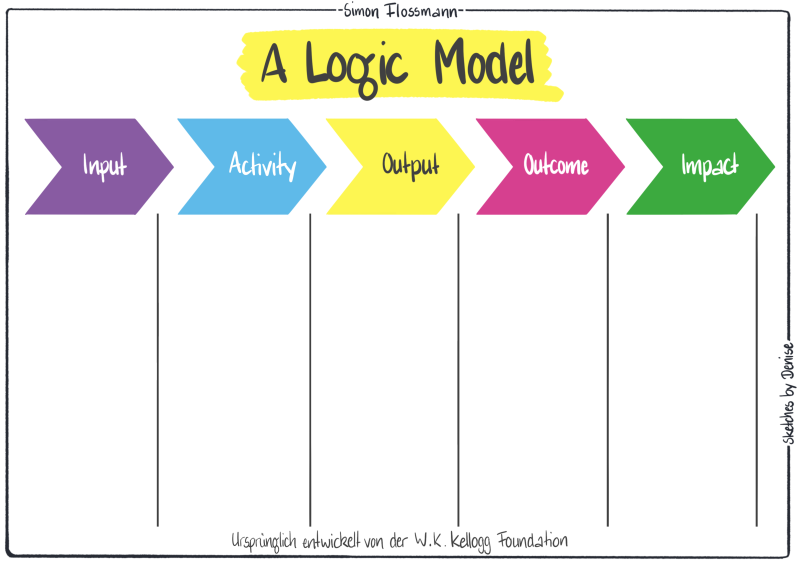
- Inputs are the resources we invest in development. Examples: time, budget, team capacity, existing technologies, external expertise.
- Activities are the concrete actions and processes we perform. Examples: user research, design workshops, feature development, testing, going live.
- Outputs are the tangible results of the work done. Examples: a new dashboard feature, an improved onboarding process, a redesigned interface, a release update.
- Outcomes describe observable changes in user behavior caused by the output. Examples: 70% of users use the new dashboard daily, 40% complete the onboarding process faster.
- Impacts express the effect of the outcomes on the company. Examples: increasing user retention, higher conversion rate, reduced support requests.
If we know these five factors, we can analyze the connections between them — especially regarding the business model.
Ideally, a good business model can be described as an equation. Otherwise, it’s impossible to make data-based improvements. Essentially, every business model equation can be derived from the relationship: Profit = Revenue – Costs. If you want to learn more about this, take a look at article "Strategic Product Goals." I explain it in more detail.
If you understand the connections of how product development works in your company and can describe them as an equation, you keep your eye on the entire value chain.
This prevents you from being dismissed by managers as a "Team Mom" or "Scrum Secretary"—and it enables a long-term career in this role.
Step #5: Invest in your network.
Many Scrum Masters attend training and conferences to learn new things.
I did the same for a long time. Now, I see it differently: Conferences, meet-ups, and training sessions primarily serve to make new contacts — not just to consume content.
Give talks yourself. Approach people who interest you during coffee breaks. Ask them about their experience or for specific advice.
Of course, you shouldn’t ask for a job in the first conversation. It’s about staying in people's minds. You want to increase the probability that your name comes up when someone is looking for a capable Scrum Master.
Here are some conferences and meet-ups I can recommend:
- Scrum Day: One of the most established Scrum conferences in the German-speaking world. Ideal for meeting like-minded people and getting in touch with Scrum Masters.
- Scrum Day Europe: Is the largest global Scrum community event of the year. It is all about learning together, growing together, and shaping the future together.
- PSM-3-Bootcamp: A community that develops their Scrum Master skills together and prepares for the PSM III exam.
...
If you can recommend a training course, a conference, or a meet-up to other Scrum Masters, write it in the comments and help others develop as Scrum Masters.