
"How can I become a Scrum Trainer?"
A question I am asked regularly. Just last week again, after my "Professional Agile Leadership – Evidence-Based Management" training in Munich. Since I promised the person an email, I thought to myself: why not let you in on it too? Are you also toying with the idea of becoming a Scrum trainer or a trainer in general? Then this article is for you.
Let’s go…
At the end of 2017, I registered for the "Professional Scrum Master III" exam for the first time.
I wanted to prove that I had become really well-versed in Scrum by then.
Secretly, I was already considering becoming a Scrum trainer someday. The exam represents the entry barrier for trainers. I followed the common advice from Scrum forums: leading up to the exam, I read every book about Scrum available on the market.
After 20 minutes of the exam, I actually should have been at question 6.
However, I hadn’t even answered the second question. I found it difficult to answer the questions correctly in terms of content. Additionally, I failed to get the answers to the point concisely in a few sentences without rephrasing them several times. At times, I was completely out of it, and even simple English words escaped me. In the end, I only had ten minutes left to answer the last seven questions.
After submitting the exam, I checked my emails several times a day. I was aware that the exam had gone anything but well. But I didn't want to give up hope yet. Maybe I had been better than I thought? Or maybe the markers would turn a blind eye just this once… or maybe…
Then finally: I had a reply from the marker in my inbox:
„... in several cases, your answer lacked the depth needed to get full marks. Brief answers are often best, but there were times where they were too brief."
After reading these lines, I closed my notebook. And with that, I also said goodbye to the dream of becoming a Professional Scrum Master III.
For the time being.
A few weeks later, I spoke on the phone with my mentor. He was a Professional Scrum Trainer with many years of experience—and one of the few I had initiated into my dream of becoming a Scrum trainer. Naturally, the conversation eventually turned to the exam. At first, I hedged, but then I told him everything. While telling the story, I realized something:
I had made it too easy for myself with the exam preparation.
Reading books is pleasant, but it is just reading. However, the exam requires writing. That means active doing, not passive sitting on the sofa with a book. When I realized this, I wanted to pull my hair out. I really should have known better. From my mathematics studies, I knew that just sitting in a lecture and listening was not sufficient preparation for the final exam. I had to engage with the topic myself. I had to ask myself questions. I had to take notes. And above all, I had to solve problems. Only when I could actually solve problems with my knowledge did I pass the exam at the end of the semester.
Therefore, after the conversation, I decided: From today on, I would answer one tricky question about Scrum daily. Knowledge and experience alone were not enough to pass the "Professional Scrum Master III" exam; rather, I had to get my experiences onto paper quickly. That was what I wanted to train from now on.
At the end of 2019, I passed the exam with 95%. And a few months later, I was even accepted into the community of Professional Scrum Trainers.
Which tips can I give you in retrospect from my preparation?
Tip #1: As a trainer, you must be able to answer questions to the point
Reflecting on my preparation, one insight stands out first: knowing about Scrum is not enough. Scrum trainers must be able to present important content precisely.
When I speak of important content, I mean:
- The Scrum principles
- The Scrum values
- The elements of Scrum
- The concept of "Done"
- Sprint and Product Goals
- Complex work
- The role of self-management
- Planning and forecasting
And it is not enough to just be able to explain this content; as a Scrum trainer, you must be able to use this content to answer participants' questions. A good training should less resemble a university lecture and more a dialogue between trainer and participants. And the key to this conversation at eye level is the ability to answer questions about product development with content from the Scrum framework.
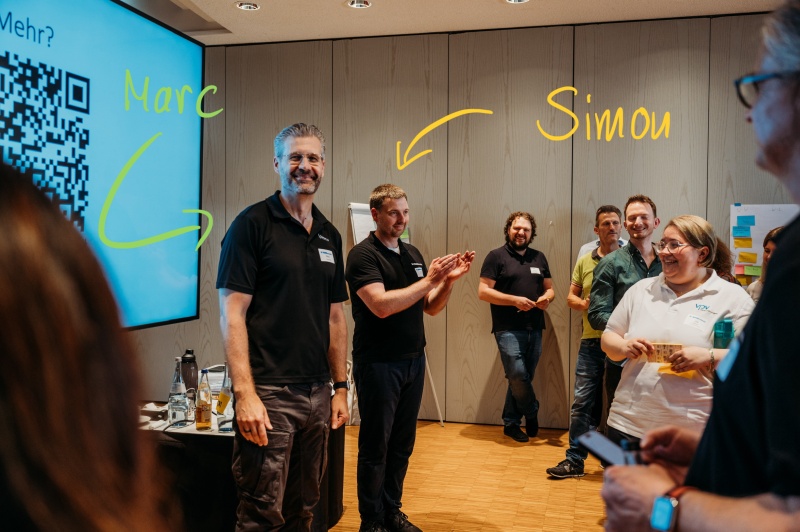
Exactly these skills are what you must prove in the "Professional Scrum Master III" exam. That is why this is part of the path that aspiring Scrum trainers at Scrum.org must take. Since there is no support for this in the form of a training from Scrum.org and I want to spare everyone the lonely path of self-study, Marc Kaufmann and I launched the PSM 3 Bootcamp.
Of course, it is not enough to only answer questions with the knowledge from the Scrum Guide. Which brings us to the next tip:
Tip #2: Only extensive Scrum experience creates trust in your knowledge
How do you recognize an experienced Scrum trainer?
I use this test: What distinguishes the Product Backlog from the Sprint Backlog?
By this simple question, I have always been able to tell whether someone has truly worked in a Scrum team before or not. Sounds simple, but trainers who only have their knowledge from the Scrum Guide or books cannot explain what actually happens in Sprint Planning.
They do not understand:
- What role the struggle for the appropriate Sprint Goal plays,
- How a Product Backlog only describes the "What" and the Sprint Backlog the "How",
- Why Product Owners only decide on the "What" and Developers only on the "How".
Many years of experience (at least five to seven years) in Scrum teams, ideally in different accountabilities, is important to be authentic. By "authentic," I mean having experienced the difficulties of implementing Scrum in real companies firsthand. And especially: having successfully overcome these difficulties. A Scrum trainer must inspire the training participants to take action, and that will never work if they cannot tell how they have already managed it.
When I made the decision to become a Scrum trainer, I therefore started collecting these stories. However, collecting is not enough. As with the last tip, it is about being able to share these experiences concisely.
I use these questions to get the experience to the point:
- What was the situation?
- What was the problem? What deviation from the Scrum framework existed?
- What did I try to solve the problem?
- What was the result of my attempts?
- What have I paid attention to ever since?
One way to exchange ideas with other Scrum Masters and share experiences is the "Professional Scrum Master – Advanced" training. Anyone seriously considering becoming a Scrum trainer should attend this training. Because in addition to the content and the opportunity to share experiences and learn from other Scrum Masters, it also offers the chance to experience what an interactive training can look like.
Which brings us to the last tip.
Tip #3: Experience as a trainer is a prerequisite
This surprised me too.
In my certification process to become a "Professional Scrum Trainer" at Scrum.org, the focus was exclusively on being able to explain Scrum and answer difficult questions confidently. I learned very little about how to design and conduct trainings well. When I supported a Scrum Master some time ago in also becoming a Scrum trainer, I therefore asked again why so little emphasis is placed on training-skill education.
The answer: A Professional Scrum Trainer is expected to already be a trainer. In other words: without experience in conducting trainings, you will probably not even be considered.
Looking back, I now understand why one of the first questions in my application back then was how many trainings I had already conducted independently. Since I had used almost every vacation in the first years of my preparation to shadow Scrum trainers or act as a co-trainer, I was able to answer this question with a high number.
Therefore, my last tip: Gain experience as a trainer.