
The Definition of Done creates transparency by providing everyone a shared understanding of what work was completed as part of the Increment.
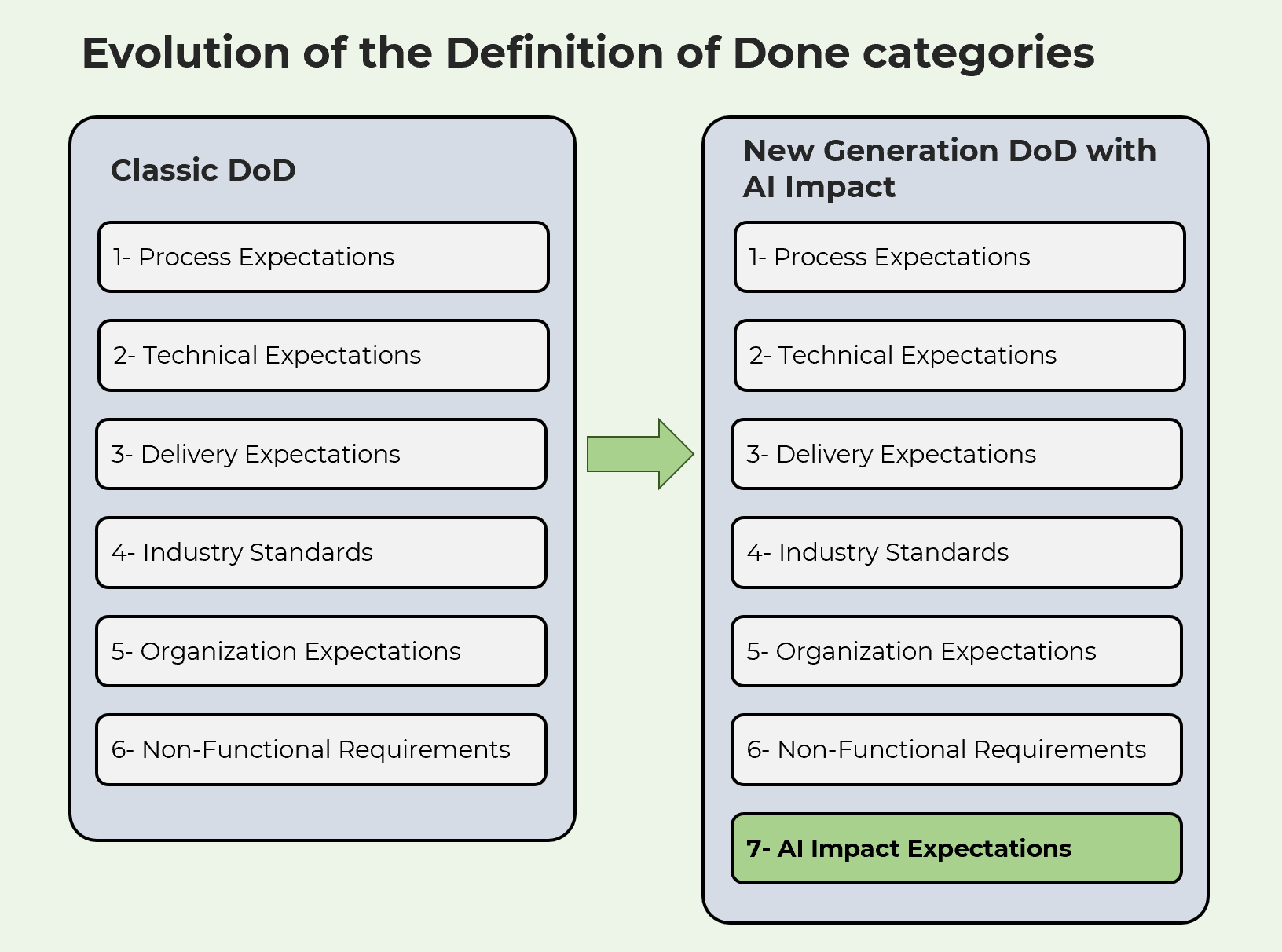
If AI changes how you build, your Definition of Done should represent it.
When you want to create a robust Definition of Done, you should think of 6 main categories of expectations:
1- Process expectations
2- Technical expectations
3- Delivery expectations
4- Industry standards & expectations
5- Organization expectations
6- Non-Functional Requirements
Imagine this is a Definition of Done for a double-sided learning platform named MetaLearn that connects trainers with learners.
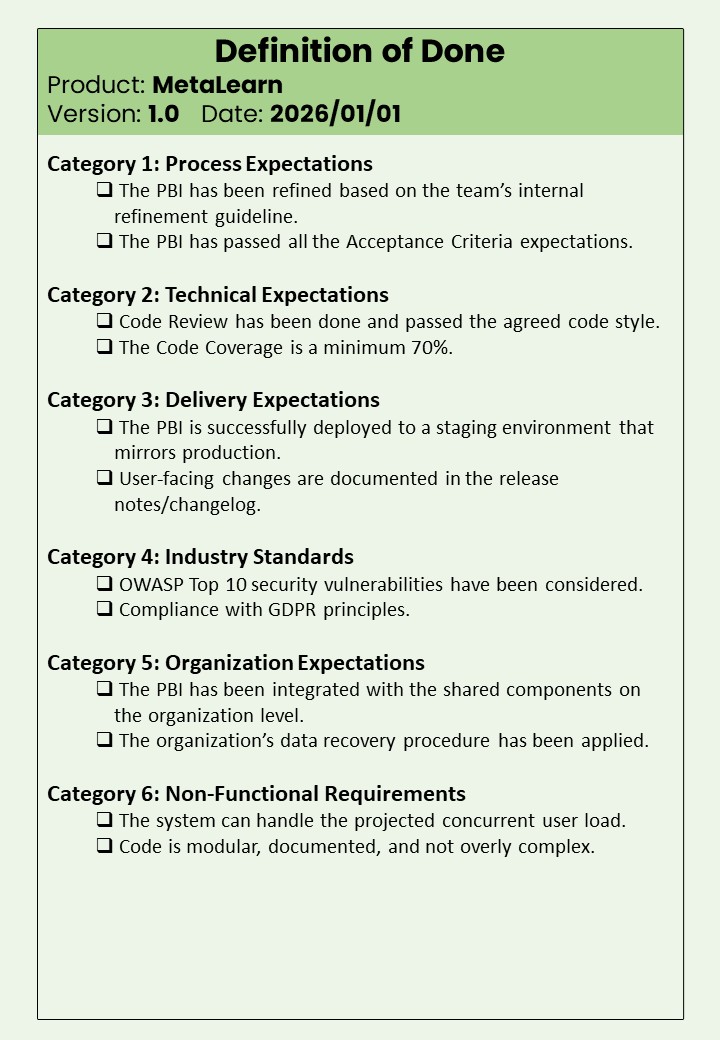
Now, imagine that your team started using AI to build the product. What type of AI-specific expectations do you need to consider?!
Let me give you some examples:
- The PBI doesn’t generate biased responses
- The PBI responses follow fairness
- Human-in-the-Loop (HITL): Human review is available if a user requests
- The connections with AI-specific APIs are encrypted
- The PBI conforms to the “EU AI Act” regulation
- The outputs of the PBI are explainable and transparent
- The PBI doesn’t generate toxic responses
- The user data, as the prompt, is stored securely
- …
So, the elevated DoD will be something like this:
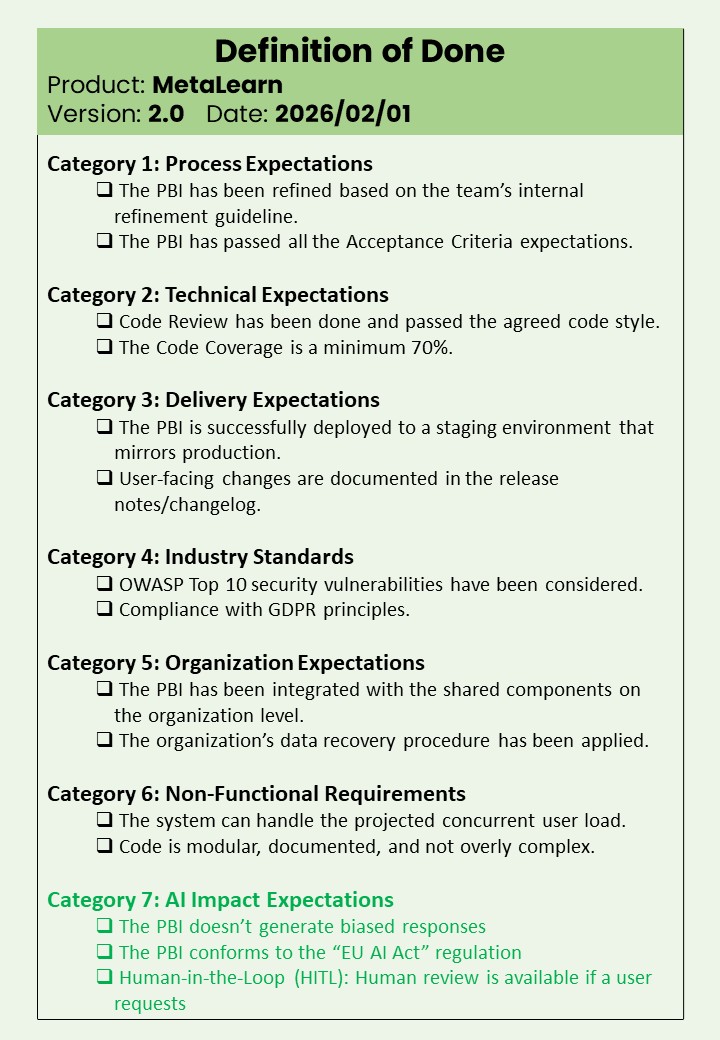
This shows a new generation of the Definition of Done impacted by AI that will become a normal expectation very soon.
So, the new generation of DoD will include 6+1 categories of expectations:
1- Process expectations
2- Technical expectations
3- Delivery expectations
4- Industry standards & expectations
5- Organization expectations
6- Non-Functional Requirements
+
7- AI Impact Expectations
--------------------------------------------------
Are you a Scrum Master?
Then, if you want to invest in learning AI and become an AI-aware Scrum Master, attend my upcoming Professional Scrum Master – AI Essentials class. Click here to get more information about the class.
Are you a Product Owner?
Then, if you want to learn how to effectively leverage AI for the new generation of product management, attend my upcoming Professional Scrum Product Owner – AI Essentials class. Click here to see the class information.