
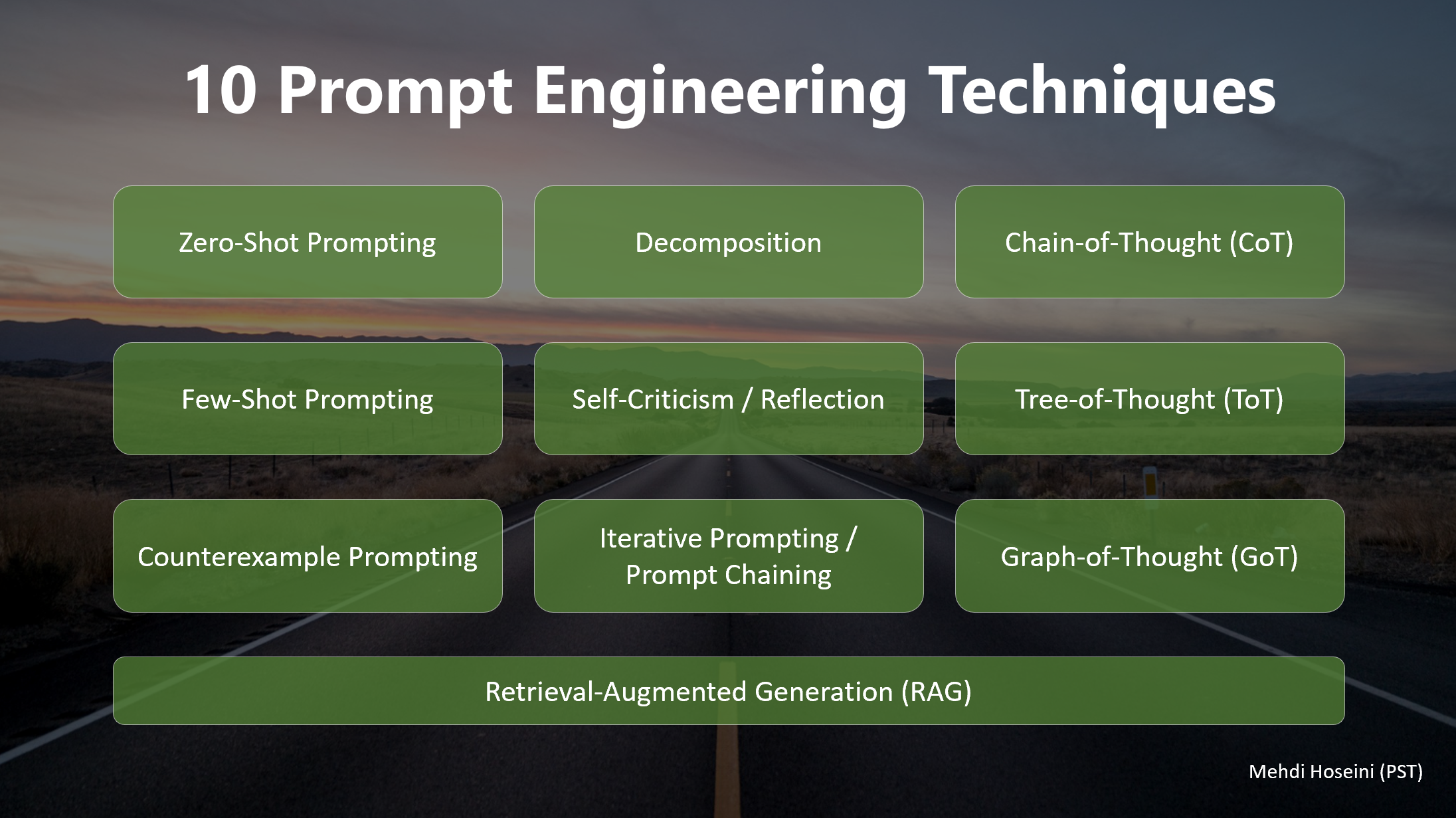
1- Zero-Shot Prompting
Asking the model to perform a task without providing any examples. The model relies solely on its pre-trained knowledge.
Example:
"Translate 'hello' to Spanish."
2- Few-Shot Prompting
Providing a few examples (input-output pairs) within the prompt to demonstrate the task. This technique, also known as in-context learning, helps the model understand the pattern or format you expect.
Example:
Classify the sentiment of these restaurant reviews.
Review: "The pizza was cold and the waiter was rude."
Sentiment: Negative
Review: "Best pasta I've ever had! Will come again."
Sentiment: Positive
Review: "It was okay, nothing special but not bad."
Sentiment: Neutral
Review: "The ambiance was lovely, but the steak was overcooked."
Sentiment:
3- Counterexample Prompting
Showing AI examples of incorrect or undesirable outputs, explain why they are wrong, and then instruct the AI to produce a correct response instead.
Example:
You are a professional business communication assistant. Write a concise, formal email confirming a meeting time.
Incorrect example (DO NOT write like this):
“Hey! Just wanted to check if we’re still on for tomorrow lol. Let me know 😊”
Problems with the incorrect example:
- Too casual
- Uses slang and emojis
- Not concise or professional
Correct style requirements:
- Formal greeting
- Clear confirmation of date and time
- Professional tone
- No emojis or slang
Now write the email.
4- Decomposition
Breaking down a large, complex task into a series of smaller, more manageable sub-tasks. This can be done by chaining prompts together, where the output of one step becomes the input for the next.
Example:
Goal: Creating a 3-month marketing plan for a new mobile app that helps people track their daily water intake.
Step 1: We are launching a mobile app that helps people track their daily water intake. Act as a market research analyst. Create a list of the top 3 types of potential users.
Step 2: Based on the three user types you just identified act as a marketing strategist. For each user group, suggest one specific marketing angle or 'hook' that would grab their attention.
Step 3: Now act as a Content Creator. For each user type and their hook, write 3 short social media captions (one for LinkedIn, one for Instagram, one for TikTok).
5- Self-Criticism / Reflection
Asking the AI to critique or evaluate its own output.
Example:
You can prompt it with requests like "Rate the quality of your answer" or "What are the potential weaknesses of this proposal?" to refine and improve the response.
6- Retrieval-Augmented Generation (RAG)
Combines prompt with real-time, external knowledge and sources, fetches relevant context before generation. Great for enterprise or knowledge-heavy use cases.
Example:
Describe Daily Scrum aligned with what is in the Scrum Guide.
7- Chain-of-Thought (CoT)
Encouraging the model to break down its reasoning step-by-step before giving a final answer. This is particularly effective for math, logic, and multi-step problems.
Example:
Roger has 5 tennis balls. He buys 2 more cans of tennis balls. Each can has 3 tennis balls. How many tennis balls does he have now? Let's think step by step.
Reasoning:
Output:
A. Roger starts with 5 balls.
B. He buys 2 cans.
C. Each can has 3 balls, so that's 2 * 3 = 6 balls from the cans.
D. 5 + 6 = 11 balls.
So the answer is 11.
8- Tree-of-Thought (ToT)
An extension of Chain-of-Thought that prompts the model to explore multiple different reasoning branches or possibilities at each step. It evaluates these different "thoughts" and can backtrack, allowing for more complex and exploratory problem-solving.
Scenario
Goal: You are writing a short fantasy story. You have the beginning and the ending, but you need to figure out the middle content that connects them logically and creatively.
To implement ToT, you need to prompt the AI to do three things:
Branch: Generate multiple distinct possibilities (the "branches" of the tree).
Evaluate: Judge the pros and cons of each branch.
Explore/Select: Pick the best branch to continue, or combine elements from different branches.
9- Graph-of-Thought (GoT)
Builds on Tree-of-Thought (ToT) by using a graph structure, which allows for even more complex relationships between ideas. Different "thoughts" can be combined, merged, or cycled, making it suitable for highly sophisticated tasks.
10- Iterative Prompting / Prompt Chaining
This involves using the AI in a back-and-forth manner. For example, you can ask the AI to interview you to gather requirements, then refine a plan, and finally ask for a self-reflection on the proposed solution. This collaborative process helps clarify complex goals.
--------------------------------------------------------------------------
Are you a Scrum Master?
Then, if you want to invest in learning AI and become an AI-aware Scrum Master, attend my upcoming Professional Scrum Master – AI Essentials class. Click here to get more information about the class.
Are you a Product Owner?
Then, if you want to learn how to effectively leverage AI for the new generation of product management, attend my upcoming Professional Scrum Product Owner – AI Essentials class. Click here to see the class information.