
In my previous article on the Time Poverty Paradox, I showed how 92% of Product Owners own revenue outcomes while 50% lack time for evidence-based analysis. This reveals the hidden constraint: organizations haven’t designed decision infrastructure.
You can allocate accountability all day. If nobody knows who decides what, when, or with what evidence, decisions either don’t get made or get made badly.
Product Ops in 2026 is moving upstream from process maintenance to actively designing how organizations make decisions under uncertainty[¹]. The center of gravity shifts from keeping the machine running to shaping decision flow.
This isn’t an operational detail. It’s the structural solution to time poverty.
The Decision Rights Gap
Most organizations confuse activity with accountability.
They create RACI charts mapping who gets consulted on decisions. They document approval workflows showing escalation paths. They hold governance meetings where senior leaders weigh in on product priorities.
None of this clarifies who actually decides.
GitLab defines decision velocity as an organization’s ability to increase the quality and quantity of decisions made in a particular time period through behavioral and logistical agreements[²]. Quality and quantity — not just speed.
The distinction matters. Moving fast on unclear decisions wastes time. Making high-quality decisions slowly misses market windows. Decision velocity requires both.
But velocity depends on infrastructure. High-performing teams push decisions to the lowest competent level because they’ve designed systems that make pushing decisions down actually work[²]. Clear decision rights. Context availability. Feedback mechanisms that surface when decisions fail.
Without that infrastructure, pushing decisions down just creates confusion about who owns what.
Why AI Raises the Decision Stakes
Gartner predicts 40% of enterprise applications will include task-specific AI agents by 2026, up from less than 5% today[³]. These aren’t chatbots. They’re autonomous systems that execute complex, end-to-end tasks.
Which means more decisions get made faster — by humans, by AI, by humans-with-AI.
The stakes shift when building gets easier. The constraint isn’t execution capacity anymore. It’s judgment clarity[⁴]. Can you articulate what problem you’re solving? For whom? Why this solution instead of that one?
When engineering constraints forced ruthless prioritization, unclear thinking got exposed in backlog negotiations. Limited capacity meant you couldn’t build everything, so teams had to defend choices.
Now you can theoretically build almost anything. Which exposes whether you actually know what to build.
Product Ops designing decision infrastructure answers a fundamental question: who has authority to commit organizational resources based on what evidence, measured against which outcomes?
That’s not process documentation. It’s organizational capability.
What Decision-Grade Infrastructure Looks Like
Product Ops moving upstream means creating systems where good decisions become repeatable.
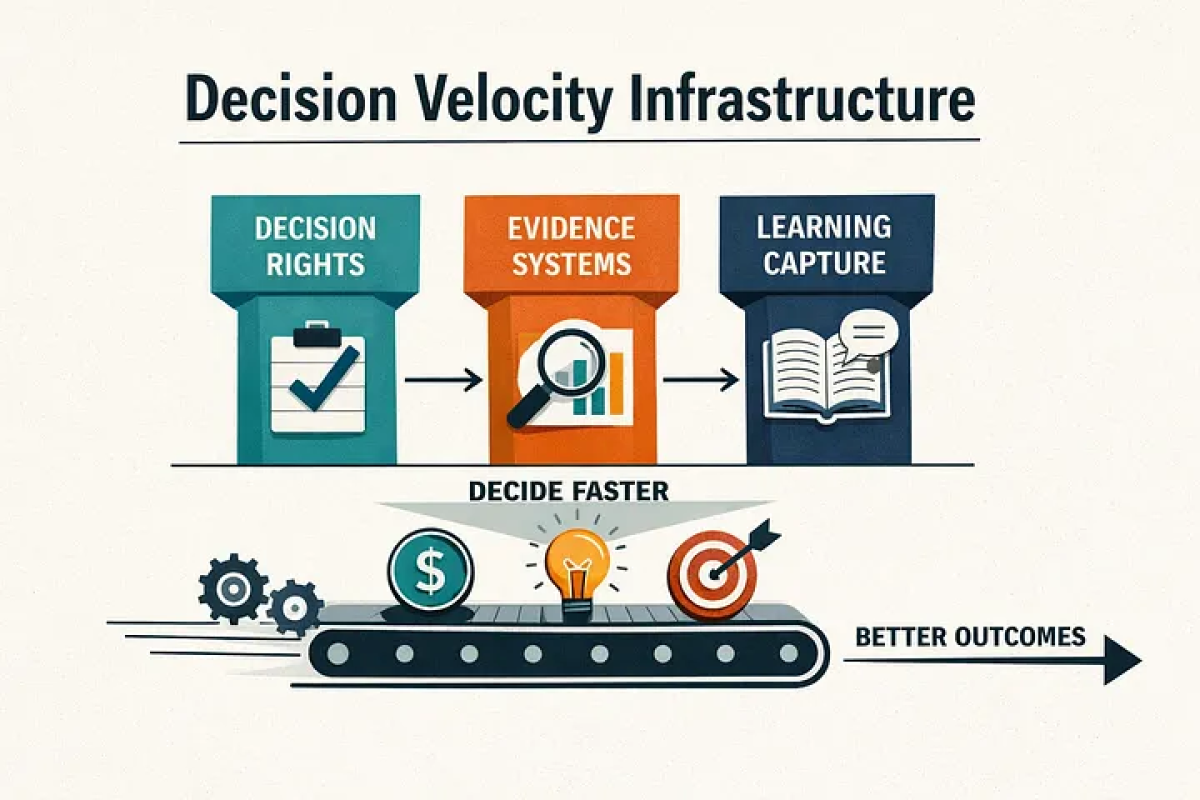
The Product Ops Predictions 2026 report identifies three elements of decision-grade infrastructure[¹]:
First, clear decision rights. Who decides what product to build? Who decides when to kill features? Who resolves conflicts between engineering feasibility and customer demand? These aren’t questions for escalation — they’re design choices about where decision authority lives.
Organizations that document decision rights create clarity. This team owns go-to-market timing. That leader decides pricing structure. This group resolves trade-offs between technical debt and feature velocity.
When everyone knows who decides, people stop asking permission and start making decisions.
Second, decision-ready evidence. You can’t make evidence-based decisions if assembling evidence takes three weeks. Decision infrastructure includes the systems that make relevant data available when decisions get made.
Evidence-Based Management provides four lenses that make decision quality measurable: Current Value, Unrealized Value, Ability to Innovate, and Time to Market[⁵]. These aren’t metrics you calculate quarterly — they’re real-time signals that inform daily choices.
Product Ops designs the measurement systems that surface these signals. Dashboards showing conversion patterns. Feedback loops capturing customer behavior. Analytics revealing where value gets created versus where it gets consumed.
When evidence is ready, decisions improve.
Third, learning capture mechanisms. Organizations make thousands of product decisions. Most vanish into Slack threads, meeting notes, or individual judgment calls.
Decision infrastructure captures rationale and dissent[¹]. Why did we choose Option A over Option B? What assumptions did we test? What evidence would change our minds?
GitLab’s TeamOps framework emphasizes documented workflows and operational transparency[²]. When decisions get recorded, future teams learn from past choices — which compounds organizational capability over time.
The RPV Lens on Decision Infrastructure
In my January article on the RPV framework, I showed how organizational capability migrates from Resources to Processes to Values.
Decision infrastructure follows this evolution. Organizations start by hiring people who make good decisions. Then they codify decision-making into workflows and approval gates. Eventually they embed decision principles into culture — where teams make autonomous choices aligned with strategic intent.
Product Ops designing decision infrastructure accelerates migration to that Values stage. You’re not documenting how decisions get made today. You’re designing systems that enable better decisions tomorrow — without coordination overhead.
From Time Poverty to Learning Velocity
The Time Poverty Paradox identified the structural problem: revenue accountability without analytical capacity.
Decision infrastructure provides the structural solution.
When decision rights are clear, product leaders stop spending time figuring out who should decide. When evidence is ready, they stop compiling data for governance meetings. When learning gets captured, they stop reinventing solutions already solved elsewhere.
That creates capacity — not calendar time, but analytical space.
Translate this to measurable practice. Continuous feedback from customers. Dynamic value quantification through Evidence-Based Management. Unified product intelligence across teams.
When those systems exist, decision velocity increases because the infrastructure supports quality decisions made quickly. Product Ops building this infrastructure isn’t operational support. It’s strategic capability design.
What to Build First
Start with decision archaeology. Map where product decisions actually get made — not where org charts say they should happen, where they do happen.
Who decided to delay that feature? Who chose this pricing model? Who resolved the conflict between customer requests and technical constraints?
Identify the decision patterns that repeat. Prioritization. Build-versus-buy. Resource allocation. Market entry.
For each pattern, design three elements: decision rights (who has authority, what evidence they need), evidence systems (data that improves decisions without manual compilation), and learning capture (how rationale and dissent get documented).
Start with one high-frequency decision type. Design the infrastructure. Measure whether decision quality improves. Expand to the next pattern.
Decision infrastructure becomes organizational muscle memory through incremental building, not transformation programs.
The Capability Product Ops Actually Builds
Product Ops began as operational support — managing tools, facilitating planning, coordinating releases.
The 2026 shift positions Product Ops as the function that designs decision flow[¹]. Not the team that executes processes, but the group that architects how product organizations make choices under uncertainty.
That’s systems thinking applied to organizational capability.
You’re designing the structures that enable better decisions. The processes that make evidence available. The values that push authority to the people closest to customers.
When Product Ops builds decision infrastructure, they solve the Time Poverty Paradox systemically.
Product leaders gain analytical capacity not because calendars get reorganized, but because decision systems eliminate coordination waste. Teams move faster not because they skip rigor, but because decision-ready evidence makes rigor efficient.
As AI makes building easier, the bottleneck shifts from execution to judgment[⁴]. Organizations that design decision infrastructure will make better choices faster than competitors still running decisions through 2020 governance processes.
That’s not a productivity gain. It’s competitive advantage.
Decision velocity infrastructure — who decides what, with which evidence, captured how — might be the highest-leverage investment Product Ops can make in 2026.
Because the constraint isn’t time. It’s organizational design.
Ralph Jocham is Europe’s first Professional Scrum Trainer, co-author of “Professional Product Owner,” and contributor to the Scrum Guide Expansion Pack. As an ICF ACC certified coach, he works with organizations to build Product Operating Models where strategic clarity, operational excellence, and adaptive learning create measurable competitive advantage. Learn more at effective agile.