
Working agreements help a team deliberately create an atmosphere of trust and psychological safety where people can take risks, talk about hard things, and accept accountability. In the Scrum pattern Norms of Conduct, working agreements are described as a set of specific, observable behavior patterns that the team defines for itself and adopts voluntarily: a way to turn abstract values like “respect” and “openness” into clear “what we do / do not do” actions in everyday work. These agreements reduce friction, make it easier to resolve conflicts, align expectations inside the team, and create a foundation for mutual accountability.
Working agreements are especially valuable for teams at the very beginning, when people are just coming together, old habits are pulling them in different directions, and there are no shared norms yet. For teams that have been working together for a while, they are also a powerful “reset” tool: at any time the team can acknowledge that the current unwritten rules are not serving them and deliberately agree on how they want to work together going forward.
The approach I use starts with a picture of the future. First, we co‑create a one‑year team vision: what kind of “super‑team” we want to become. I build on the Innovation Game Remember the Future: we mentally move people into the future and ask them to describe what an ideal work year looks like if everything has gone as well as possible. I split people into small groups of 3–5, give each group the Team Vision canvas, and they fill it in for about 20 minutes before presenting their results to each other. The team then votes on the strongest parts of these visions, and this is how a shared picture of “who we want to be” emerges.
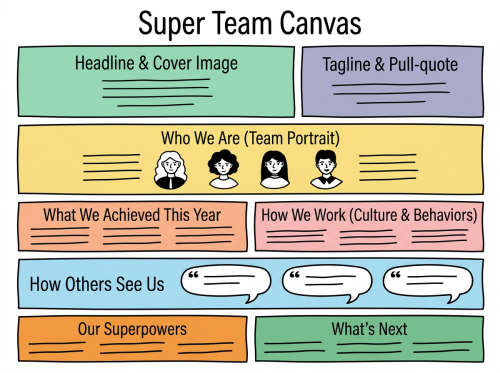
Team Vision Canvas
Next, we translate this future picture into the language of behavior. Together, we start generating concrete, measurable, and observable examples of what we want to see in the team. To warm up that muscle, I offer a few examples in an “if X, then I do Y within this time frame” format:
- “If I realize I won’t finish a task on time, I raise my hand at least 24 hours before the deadline (no later than X:00 the day before).”
- “We respond to messages in the team chat within working hours no later than 2 hours after they are sent.”
- “If something makes me angry or worried, I go directly to the person within 24 hours instead of discussing it behind their back.”
- “In meetings we do not interrupt each other: we speak in turn, one person talks, everyone else stays quiet until they finish their sentence.”
- “We start all scheduled meetings no later than 5 minutes after the planned time.”
Next, the team goes back into small groups and generates its own behavior patterns that fit the chosen vision. People rarely have a strong skill in formulating behavior concretely, so we iterate on the wording several times until the statements become clear and testable in real life. In the end, we run a multi‑voting exercise and select 5–9 key patterns — the ones the team is truly ready to uphold and protect.
To keep working agreements from dying the very next day or turning into a static document, I always connect them to regular feedback cycles. We introduce a simple 360‑degree feedback and behavior‑discussion format inside the team, using the agreements as a shared reference point: “this is what we ourselves decided.”
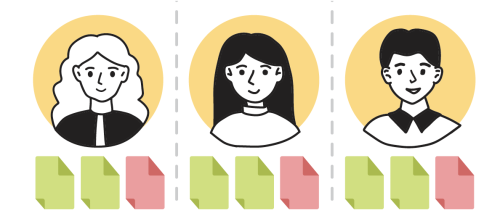
It is important to do this in a safe format, so I usually use the Non‑Violent Communication (NVC) framework: we talk about facts, our feelings, and our needs instead of labeling and interpreting people, and we formulate concrete requests for future behavior. This way, the working agreements become a living tool: the team returns to them regularly, checks what still works and what needs to be rewritten, and gradually shapes its own interaction culture.