
Your calendar is full of retrospectives, plannings, and dailies.
The Jira board is already prepared for the next Daily. The “The good, the bad, the ugly” retrospective in the evening is also fully prepared. The new planning poker cards have been ordered. Are you new as a Scrum Master? Then this would probably be a sign that you are doing a good job.
But do you want to build a career as a Scrum Master?
Then it takes more than just moderating meetings well. Don’t get me wrong: facilitation is an important skill for Scrum Masters. But it is only ONE skill among many. Do you want to know in which areas you can still improve as a Scrum Master?
Then use these five questions to assess yourself. Read the explanation and then rate yourself on a scale from 1 to 5. Be honest – no one is watching. 🫣
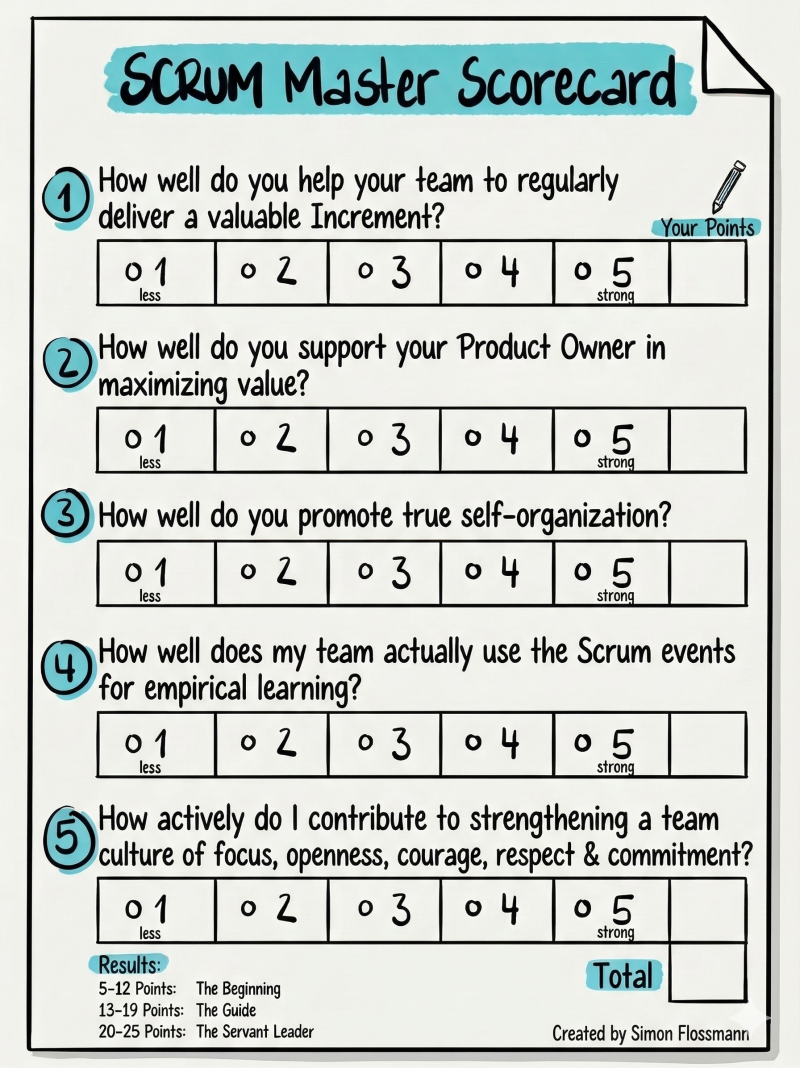
Let’s start with the first and most important question:
Question #1: How well do you help your team deliver a valuable Increment regularly?
Many teams complain about micromanagement.
Why do stakeholders keep dropping into the Daily Scrum uninvited? Why are you, as Scrum Master, asked for status reports after the Sprint? Why does the Product Owner have to prove which planned features were actually delivered?
The uncomfortable truth is often this:
There is a lack of trust in the team’s ability to deliver.
When stakeholders do not see that something is finished, they start to control. As a Scrum Master, you do not serve your team by using your moderation skills to hide the fact that your team is not yet able to deliver. You serve them best by helping them focus radically on delivering Increments that meet the Definition of Done. Because without a finished Increment, there is no transparency, no empiricism, and no real feedback.
Your job is to hold up a mirror to the team and help them deliver usable versions of the product.
Assess your current situation:
How well do you help your team deliver a valuable Increment regularly?
- 1 point: We rarely deliver anything finished. Quality is unclear or fluctuates heavily.
- 2 points: We sometimes deliver something, but “Done” is unclear or constantly debated.
- 3 points: We frequently deliver an Increment, and quality is mostly stable.
- 4 points: We regularly deliver releasable Increments and actively work on improving the Definition of Done.
- 5 points: We deliver a valuable Increment at the end of every Sprint and actively use feedback.
Your score: _____
Question #2: How well do you support your Product Owner in maximizing value – through clarity, focus, and usable data?
The Scrum Guide says:
“The Product Owner is accountable for maximizing the value.”
A sentence that often creates more confusion than guidance. What does that actually mean?
Product value is not a gut feeling. It emerges at the intersection of:
- valuable for users,
- valuable for the business, and
- valuable for stakeholders.
Amateur Scrum Masters leave the Product Owner alone and focus only on the team. That is a mistake.
A Product Owner who works in isolation creates incomprehensible Product Backlog items, which in turn leads to poor Sprints.
- Do you help the Product Owner gain access to user data?
- Do you coach them in techniques for effective stakeholder management?
- Do you ensure clarity and focus in the Product Backlog?
Assess your current situation:
How well do you support your Product Owner in maximizing value?
- 1 point: The Product Owner works in isolation; vision and prioritization are unclear to the team.
- 2 points: I provide occasional support, for example in Planning, but value and direction often remain vague.
- 3 points: We work together solidly; goals and priorities are understandable for everyone.
- 4 points: I actively strengthen the Product Owner; the vision and backlog are clearly structured and data-based.
- 5 points: Through my support, the Product Owner, team, and stakeholders work together in a measurably value-oriented way.
Your score: _____
Question #3: Do you foster real self-management – or replace it with “moderation as a service”?
This may be the hardest question for your ego.
We want to be needed. But if we moderate every meeting, remove every obstacle ourselves immediately, and lead every discussion, we train the team to become dependent.
That is called “moderation as a service.” It feels good, but it prevents real self-management.
Your job is to enable the team, not to take work off their hands. The team’s adaptability decreases when it has to wait for your instructions or your moderation. This does not mean that Scrum Masters gradually make themselves obsolete. That is nonsense. They simply turn their attention to deeper organizational problems that reduce value delivery.
Assess your current situation:
How well do you foster real self-management?
- 1 point: I usually lead through moderation; the team waits for me. Without me, nothing happens.
- 2 points: The team makes some decisions, but I often step in as the “rescuer.”
- 3 point: The team makes many decisions on its own, but still needs support with conflicts or meeting structure.
- 4 points: Self-management is strongly developed; I act as a coach, no longer as a moderator.
- 5 points: The team organizes itself confidently, takes responsibility, and even helps other teams do the same.
Your score: _____
Question #4: Does my team really use the Scrum events for empirical learning – or are we just going through rituals without decisions and improvements?
Scrum is based on empiricism: transparency, inspection, adaptation.
“A Scrum Team is expected to adapt the moment it learns anything new.”
This sentence in the Scrum Guide is often overlooked.
And so Scrum events become rituals of Scrum zombies:
- The Daily is a status report instead of a plan for the next 24 hours.
- The Review is a demo without feedback.
- The Retrospective is a complaining session without concrete actions.
If you go through meetings without making decisions, you waste the time of the team members. And since time is money, it is the company’s money.
Experienced Scrum Masters ensure that every meeting is worth the time by guiding the team toward decisions.
Assess your current situation:
How well does my team really use the Scrum events for empirical learning?
- 1 point: Events feel like meetings: little outcome, lots of obligation.
- 2 points: There is structure, but real decisions or clarity are often missing at the end.
- 3 points: The events are useful; we at least learn something new regularly.
- 4 points: Events produce clear decisions, immediate adaptations, and visible progress.
- 5 points: Every event creates focus, clarity, and measurable learning for the team. There is no wasted time.
Your score: _____
Question #5: Am I actively helping to strengthen a team culture of focus, openness, courage, respect, and commitment – and how visible is that in behavior?
Scrum does not work without values.
Because Scrum is based on the assumption that we can never know everything and cannot predict the future. We have to try out what works and what does not. That means failed experiments are unavoidable.
Scrum Teams can follow all the rules, but without openness there is no transparency about real progress. Without courage, failures are not addressed. Without respect, there is no psychological safety.
These values are not just written in the Scrum Guide. They must be visible in behavior. How does the team deal with mistakes? How do they talk about each other when someone is not in the room? As a Scrum Master, you are the guardian of this culture. Experienced Scrum Masters stand out because they have the courage to make violations of these values visible as well.
Assess your current situation:
How actively do I contribute to strengthening a team culture of focus, openness, courage, respect, and commitment?
- 1 point: The values are hardly visible; conflicts are avoided or swept under the rug.
- 2 points: The values show up occasionally, but more by chance than as a standard.
- 3 points: The values are often lived; I actively address them as Scrum Master.
- 4 points: I consciously promote the values; they shape daily collaboration and decisions.
- 5 points: The values are tangible in everyone’s behavior, and I protect them consistently, even against resistance.
Your score: _____
Your Evaluation and My Feedback
Add up your points. Where do you stand?
Your total score: _____
5–12 points: The beginner
You are probably still strongly trapped in the role of organizer or moderator.
That is okay at the start, but this is where the greatest potential lies. My tip: in the next Sprint, focus only on Question #1, a finished Increment. That solves many other problems.
Here are some additional articles with tips for this situation:
- How Can Scrum Help You Manage Risk?
- How Product Owners Can Maximize Value with Stakeholder Input
- How to get the most from your Sprint Retrospective Event
- The Scrum Values and the Real World
Enjoy reading.
13–19 points: The guide
You are doing a solid job.
The rules of Scrum seem to be well established. From here on, more empirical learning and more self-management will help your team most. My tip: try stepping back from moderation (Question #3) and demand more responsibility from the team.
- If, beyond facilitation, you are looking for other ways to support your Scrum Team, I recommend the Professional Scrum Master – Advanced training. There learn many methods and tools to strengthen your team’s self-management.
- If you specifically support your Product Owner in the team, then I recommend attending the Professional Scrum Product Owner – Advanced training. There you learn you how to work like a Product Owner.
Both will help you support your team as a coach.
20–25 points: The Servant Leader
Congratulations.
You are operating at a very high level. You are not only changing meetings, but also culture and value creation. Your next challenge:
How can you carry this mindset into the wider organization?
The answer to this question has two parts:
- External impact: First, you should be perceived as a Scrum expert within the company. The PSM III certification is a good option for this. You can find support for it in the PSM III Bootcamp. By making your expertise visible externally, the likelihood increases that you will also be included in difficult restructuring efforts.
- Professional knowledge: To successfully support reorganizations in the company, you need to establish yourself as an Agile Leader. In the Professional Agile Leadership training, you will learn how to lead with goals and metrics, and how to shape restructuring, hiring processes, and career paths in ways that promote agility.
These five questions are not meant to be a test that you either pass or fail. They are meant to serve as a compass for your development as a Scrum Master.