
In this blog, I dissect the value of private Scrum training for companies.
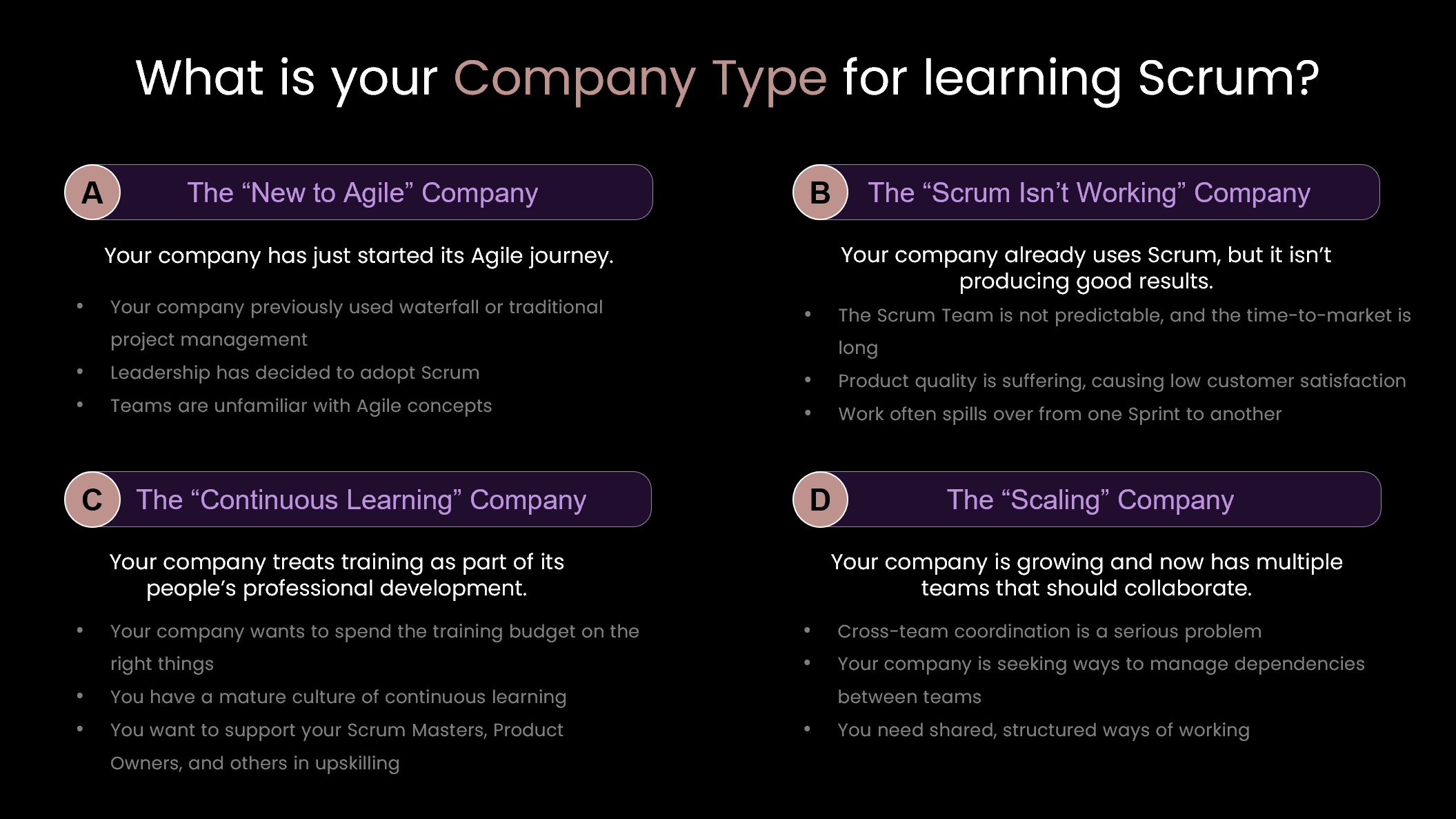
When companies decide to invest in their teams with a private Scrum training, they can be in four states. So, I have categorized them into 4 types:
Type A: The “New to Agile” Company
Your company has just started its Agile journey.
- Your company previously used waterfall or traditional project management
- Leadership has decided to adopt Scrum
- Teams are unfamiliar with Agile concepts
Type B: The “Scrum Isn’t Working” Company
Your company already uses Scrum, but it isn’t producing good results.
- The Scrum Team is not predictable, and the time-to-market is long
- Product quality is suffering, causing low customer satisfaction
- Work often spills over from one Sprint to another
Type C: The “Continuous Learning” Company
Your company treats training as part of its people’s professional development.
- Your company wants to spend the training budget on the right things
- You have a mature culture of continuous learning
- You want to support your Scrum Masters, Product Owners, and others in upskilling
Type D: The “Scaling” Company
Your company is growing and now has multiple teams that should collaborate.
- Cross-team coordination is a serious problem
- Your company is seeking ways to manage dependencies between teams
- You need shared, structured ways of working
There are significant outcomes from private Scrum training worth considering. Let's check them:
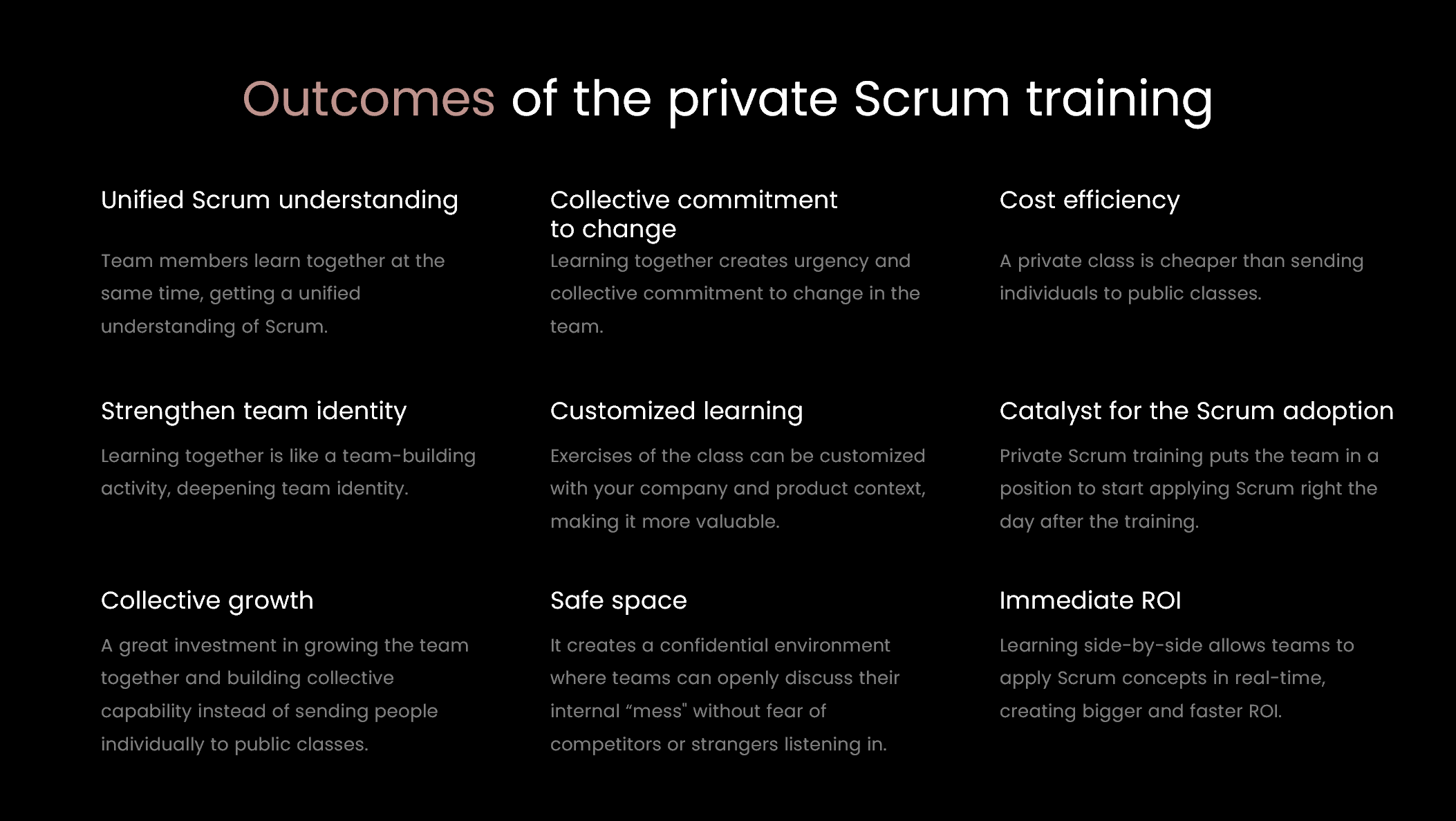
1- Unified Scrum understanding
Team members learn together at the same time, getting a unified understanding of Scrum.
2- Collective commitment to change
Learning together creates urgency and collective commitment to change in the team.
3- Cost efficiency
A private class is cheaper than sending individuals to public classes.
4- Strengthen team identity
Learning together is like a team-building activity, deepening team identity.
5- Customized learning
Exercises of the class can be customized with your company and product context, making it more valuable.
6- Catalyst for the Scrum adoption
Private Scrum training puts the team in a position to start applying Scrum right the day after the training.
7- Collective growth
A great investment in growing the team together and building collective capability instead of sending people individually to public classes.
8- Safe space
It creates a confidential environment where teams can openly discuss their internal “mess" without fear of competitors or strangers listening in.
9- Immediate ROI
Learning side-by-side allows teams to apply Scrum concepts in real-time, creating bigger and faster ROI.
In addition, three groups are involved to make a decision to arrange a private Scrum training for companies:
1- Scrum Masters / Agile Coaches / Product Owners
They work directly with the teams and can identify the training needs.
2- Operational Leads: Team Lead / Engineering Manager / Head of Product / Line Manager / L&D Manager, ...
They want to see predictable value delivery and quality products. They usually have the training budget. They support the teams if they see improvements in their product development and delivery process.
3- Executives: CEO / COO / CTO / CPO, ...
They think of strategic outcomes for the company. So, if they see real value in a private training, they support the initiative.
These three groups should get aligned to support the growth of their teams. Here, I use the Agile Leader phrase to name all these people who are responsible for the empowerment of the Scrum Teams. Actively investigate your company's status. Are you using Fake Scrum or True Scrum? The answer to this question shows whether you need to invest in your team with a private Scrum training.
-----------------------------------------------------------------------------------------
If you are an Agile Leader who wants to seriously support your Scrum Teams, I invite you to read my free PDF guide about private Scrum training for companies.