
The M‑form is a structure where a company is split into semi‑autonomous product or business divisions with their own P&L, while the corporate center manages them as a portfolio. For decades this has been a simple way to grow: each unit has clear accountability and its own resources. In today's complex markets this is no longer enough: companies need to manage products, customer segments and shared platforms at the same time.
The SecuriOne case
SecuriOne is a European B2B provider of cyber and physical security solutions with three product lines: Endpoint Shield, Cloud Gate and IoT Guard.
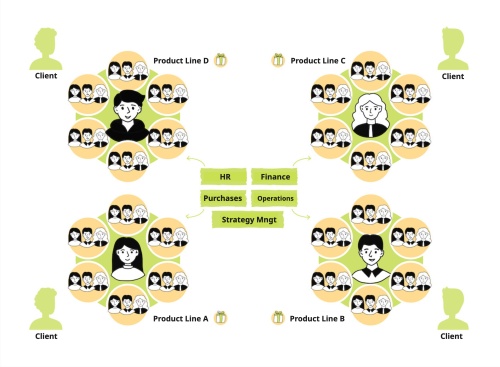
M-form structure of SecuriOne
All three are sold to the same corporate customers, and the strategy is product‑centric: each line spends around 20–25% of its revenue on its own R&D and defines its own development priorities. Sales and marketing are also split by product, so three different teams approach the same customer with separate offers as if they were three independent vendors.
Where the M‑form starts to break down
At SecuriOne, typical limitations of the M‑form appear quickly.
The customer sees a set of separate products rather than a single security partner, and the company loses large deals and cross‑sell opportunities.
Work and knowledge are duplicated: similar problems (threat analytics, cryptography, platform components) are solved differently in each unit, which raises costs and slows down the rollout of shared capabilities.
Any cross‑unit initiative runs into fights over budget and people: management systems highlight the performance of products, but hardly show profitability at the level of a client or segment as a whole.
As the market becomes more complex, the strength of the M‑form turns into a weakness: the same customer receives disconnected offers, and opportunities at the intersections of products and segments remain without an owner.
Why a multi‑dimensional organization is needed
A multi‑dimensional organization becomes necessary in several situations.
Customers behave in a multi‑dimensional way: one buyer simultaneously falls into different products, industries, regions and channels, while the company wants to capture as much value as possible through combinations of solutions.
Management dead ends appear: it is unclear who owns profitability for key accounts and large projects, knowledge is “locked” inside units, and each block optimizes only its own result.
The strategy spans several strategy focuses — product leadership, customer intimacy and operational efficiency — and requires multiple dimensions at once rather than a binary choice of “centralization or decentralization”.
The key principle: multi‑dimensionality is not implemented via a classical matrix with dual reporting lines, but by making the customer and overall economic outcome the node of intersection, not the individual stuck between two bosses.
The front–middle–back model
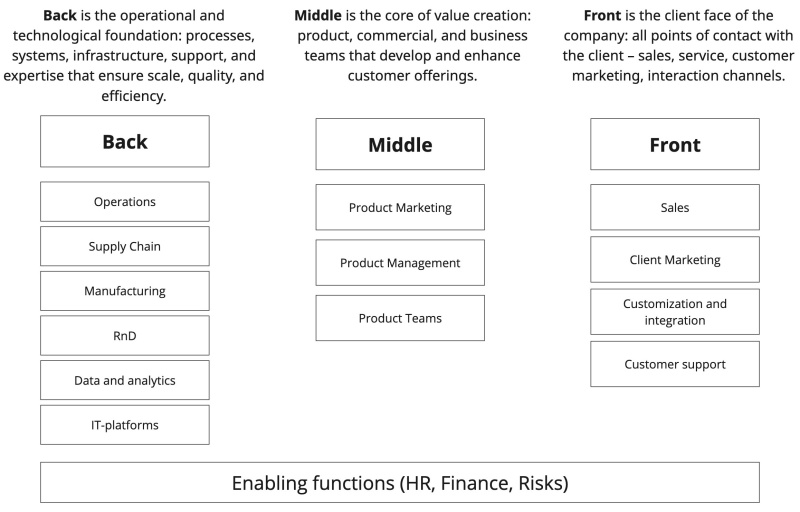
Amy Kates’s front–middle–back model helps to lay out multi‑dimensionality across three layers.
- Front: everything connected to the customer and the market — sales, key accounts, customer marketing, channels, integration of solutions and services; responsible for how the company shows up to the client and what it offers in different situations.
- Middle: owners of product and business lines — product and category units, brands, service lines; this is where portfolio and investment decisions are made.
- Back: shared platforms and resources — engineering, operations, supply chain, IT infrastructure, analytics and research; responsible for efficiency, scale and standards.
Front-middle-back model
The front collects market dimensions (customers, segments, regions, channels), the middle holds product and business dimensions, and the back manages resource dimensions, together forming a multi‑dimensional organization.
How SecuriOne changes
SecuriOne refreshes its strategy to combine product leadership with customer intimacy, keeping the three product lines as leading categories while at the same time aiming to look like a single security partner for corporate clients. In addition, the company makes flexible resource management a priority: the ability to quickly reallocate investments and expertise between directions, reduce duplicated development and increase returns on the technology base.
Multi-dimensional structure of SecuriOne
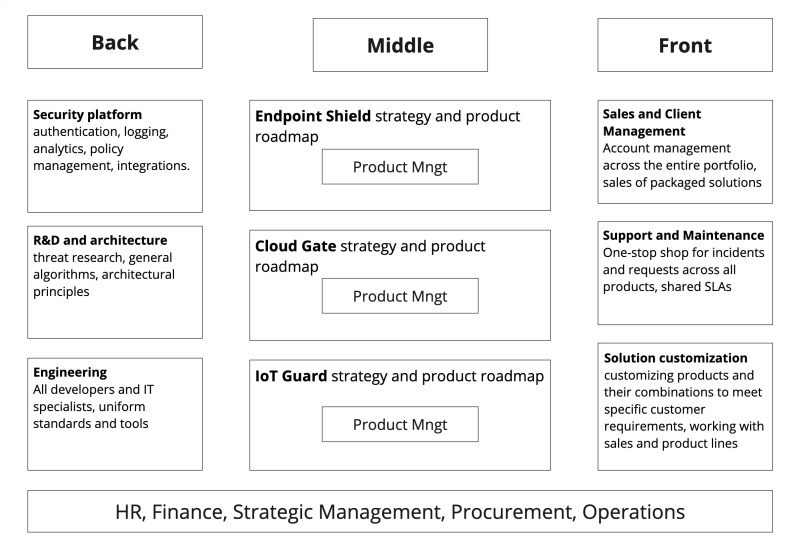
The new multi‑dimensional structure is built around the three layers.
- Back: a single engineering backbone, shared R&D, common security platforms (authentication, logging, analytics, policy management) and other foundational services; all IT specialists belong to a common pool and can be flexibly reallocated to different product groups.
- Middle: the three product lines remain owners of strategies and roadmaps and define the role of each product in the portfolio and the standard product bundles. Developers work in product groups directly with Product Owners, but are line‑managed from the back, forming logical (virtual) product groups.
- Front: a single “face to the customer” appears — unified sales, management of corporate relationships across the whole portfolio, packaged solutions tailored to industries and use cases, one support window and customization teams.
This way, SecuriOne moves from three isolated product units to a multi‑dimensional organization where product, customer and resources are managed as one system.
Takeaways
The M‑form works well while a company grows through separate product lines, but starts to slow it down when the same customers buy complex combinations of solutions and value is created at the intersections of products and segments. At that point, the right next step is neither a return to hard centralization nor a classical matrix, but a shift to a multi‑dimensional organization where front, middle and back look at customers, products and resources differently, yet are tied together by a single economic outcome. This design lets the company keep its focus on product leadership, customer intimacy and effective use of shared platforms at the same time, turning a portfolio of disconnected business units into a coherent system.