
In the previous article, we talked about how one‑dimensional organization design – when a company tries to build itself strictly around a single axis (product, function, or customer segment) – works increasingly poorly in complex B2B markets and in the modern world in general. More organizations are forced to hold several different business logics at the same time and combine several design principles instead of choosing a single one.
In this article, I go one level deeper – to how such more complex constructions are put together in practice. As a basic lens, I use the Front–Middle–Back model, which helps decompose an organization into three layers:
- Front, working with the customer;
- Middle, where differentiation happens and the strategy of products and services is formed;
- Back, responsible for platforms, operations, and scale.
It is important that the Front–Middle–Back model is not a “target org structure”, but rather a language that makes it convenient to describe different organizational patterns. Depending on where exactly the company wants to obtain differentiation – in the front, in product lines, or in platforms – the roles of these three layers and the links between them are configured in different ways. Below I will look at several typical options and show, with examples, how they are implemented in real companies.
Option A: Differentiated Middle with Consolidated Front and Back
In this option, the middle layer is a set of differentiated product lines or services that need a certain degree of autonomy in order to develop and compete in their market niche. These products rely on shared expertise and platforms, so a significant part of back functions can be shared. At the same time, customers buy not only within a single product line but also “across” them, expecting bundled and integrated solutions, which means that front teams must be able to work agnostically towards product lines and assemble end‑to‑end offerings.
Salesforce. At Salesforce, this pattern manifests itself in the way Sales, Service, Marketing, Commerce and industry solutions are structured. Common engineering capabilities and infrastructure are concentrated in the back layer, while the middle hosts relatively autonomous product and industry clouds: this is exactly where differentiation happens, strategy is formed and functionality for different scenarios and industries is developed. The front combines global sales, professional services, Customer Success and solution architects who take these modules and assemble concrete customer solutions from them, configuring and integrating them to match customer processes.
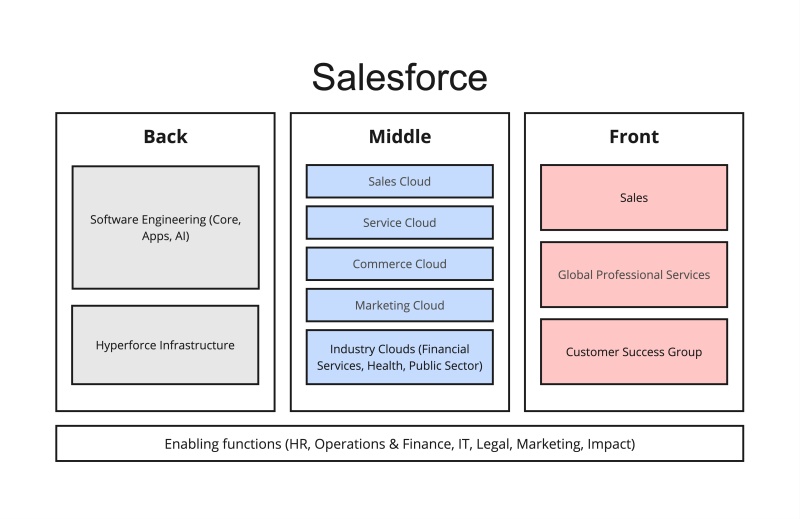
Salesforce through the Front–Middle–Back lens
USAA. A US financial group that historically serves military personnel, veterans and their families and is known for a very high level of customer centricity in its market. For USAA, “customer at the center” means not only a wide range of products (banking services, investments, life and property insurance and other financial services), but also building services around the life situations and needs of members of the association rather than around individual products. In the middle layer of USAA, there are product blocks, each with its own strategy and financial result, but relying on shared technology, analytics and operational platforms in the back layer. The front is represented by a single Member Experience block that is responsible for the key life events of customers, service channels and digital experience; this is what allows the company to maintain a very high level of satisfaction and loyalty (NPS) and to assemble integrated packages from different product lines for specific customer tasks.
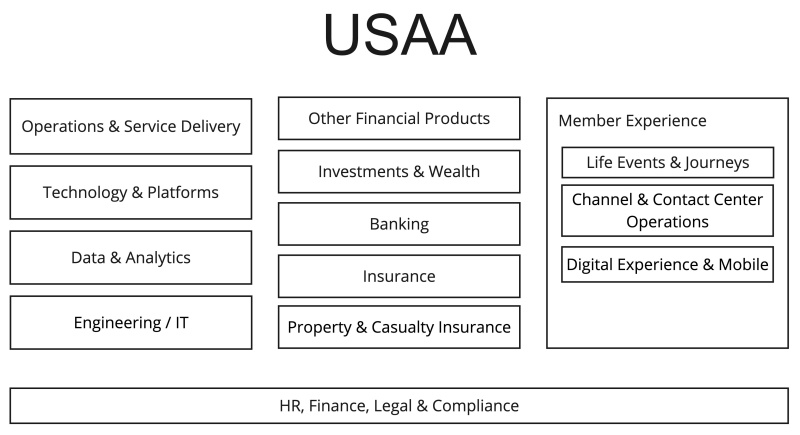
USAA through the Front–Middle–Back lens
Amazon AWS. At Amazon AWS, the middle layer consists of separate product businesses: compute services, storage, databases, networks and CDN, AI and analytics services, and so on. Each such business competes in its own segment, rapidly experiments with functionality, pricing and consumption models, but relies on shared infrastructure, internal engineering platforms and enabling functions at the back level. The front is represented by global sales, solution architects and a partner ecosystem that work across all product lines, designing coherent architectures for customers and combining AWS services into integrated solutions.
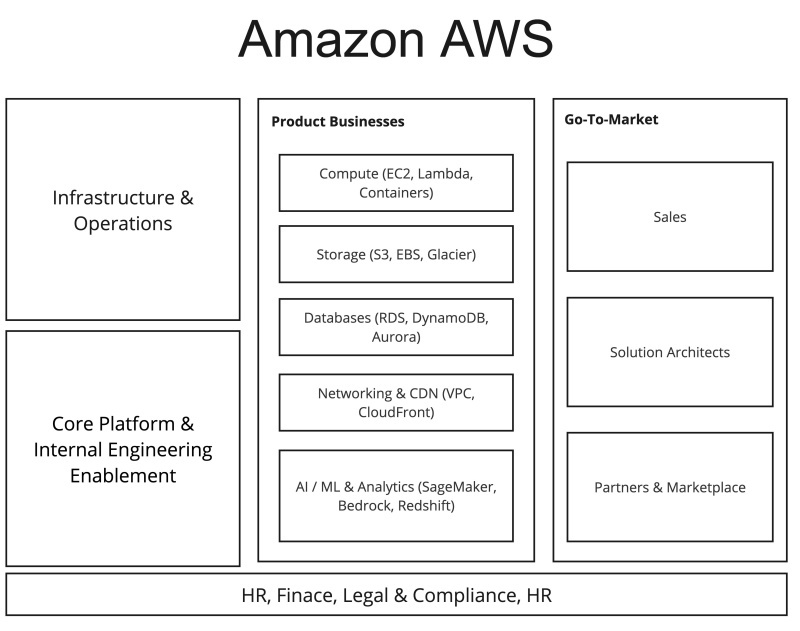
Amazon AWS through the Front–Middle–Back lens
This design is particularly appropriate where a company has several strong product lines with their own competitive logic, and customers expect complex solutions assembled from different products. It works well in situations where it is advantageous to invest in powerful shared platforms and infrastructure, as well as in a unified front that can assemble these products into coherent offerings for specific customer scenarios.
Option B: Differentiated Middle and Back with a Shared Front
In this option, products or services in the middle are so different that each of them requires its own configuration of “back‑end”: research and development, manufacturing, supply chains, specialized IT platforms and service contours. In essence, each major product line carries not only its own product strategy but also a unique set of expertise and operational capabilities. At the same time, customers can buy solutions from several lines at once and expect complex or fully integrated offerings, so the company maintains a shared front – unified key‑account sales, work with large customers and service for end‑to‑end solutions.
Siemens Healthineers. This configuration is clearly visible in major business lines: digital health and enterprise services, in‑vitro diagnostics and imaging. Each of these areas has its own product contour and its own back: specialized research and development, manufacturing of equipment and reagents, logistics and domain‑specific digital platforms. At the same time, the front is largely shared – global sales and clinically oriented teams that work with large medical institutions and healthcare systems and build complex solutions for them, combining equipment, IT platforms, service and managed services.
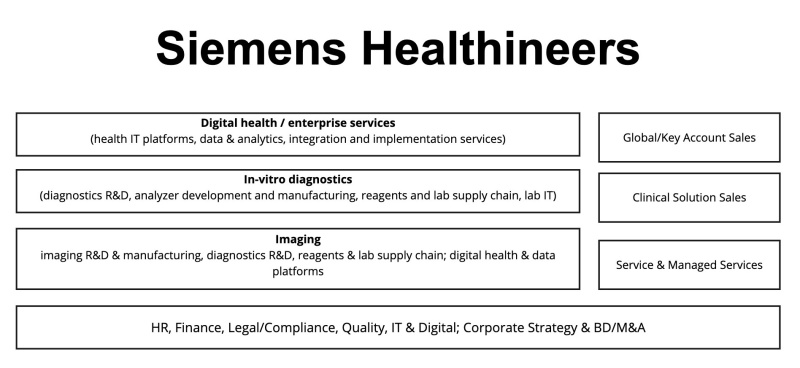
Siemens Healthineers through the Front–Middle–Back lens
Philips HealthTech. Philips HealthTech follows a similar logic: separate blocks Diagnosis & Treatment, Connected Care and Personal/Home Health rely on their own product strategies and sets of “deep” competencies in equipment development, digital platforms, analytics and service models. Each of these areas needs its own back end – from clinical engineering and domain software to telemedicine and home devices. At the same time, the front for large customers – health systems, hospitals and integrated networks – is unified: there are shared teams working with health systems, clinical solutions and lifecycle services that tie products from different lines into a single clinical and operational picture for the customer.
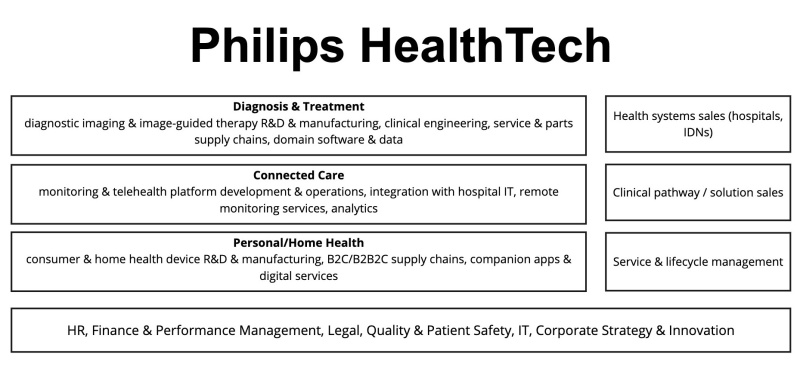
Philips HealthTech through the Front–Middle–Back lens
This design is especially appropriate where product lines not only differ but require different value‑creation chains – their own technologies, R&D, manufacturing and service models. In these conditions, it is more reasonable to build a dedicated “deep” middle and back for each of them rather than trying to force everything into a single universal factory. At the same time, customers still want to receive end‑to‑end solutions “for the task” rather than visit separate product “shops”, so it makes sense to keep the front shared. Unified teams working with key customers and partners can assemble end‑to‑end offerings from different lines without forcing the customer to deal with the company’s internal kitchen.
Option C: Differentiated Front and Middle with a Shared Back
In this option, customer segments broadly correspond to the product offering: for each major segment there is its own product logic and its own business‑development contour. Customers almost do not buy “across” lines, so the front and the middle are differentiated simultaneously: for each segment there is a dedicated block of business development, product management, marketing, sales and operations. At the same time, the products and services themselves can be built on a common platform – using a single technology base, manufacturing capacity or other key assets becomes the heart of the strategy and a source of scalable advantage.
SEB Group. A large Nordic banking group that works with corporate clients and financial institutions as well as with retail and affluent customers. In its structure, you can clearly see how customer segments turn into separate front and middle blocks: Large Corporates & Financial Institutions, Business & Private Customers Sweden, Wealth & Asset Management, Baltic and others. Each of these blocks is responsible for business development, product agenda, marketing, sales and operations in its segment, but relies on a shared back layer – infrastructure and cloud services, business technology, data and analytics and group‑wide functions. This allows the bank, on the one hand, to adapt products and services to different segments and, on the other hand, not to multiply technical and operational complexity thanks to a single platform base.
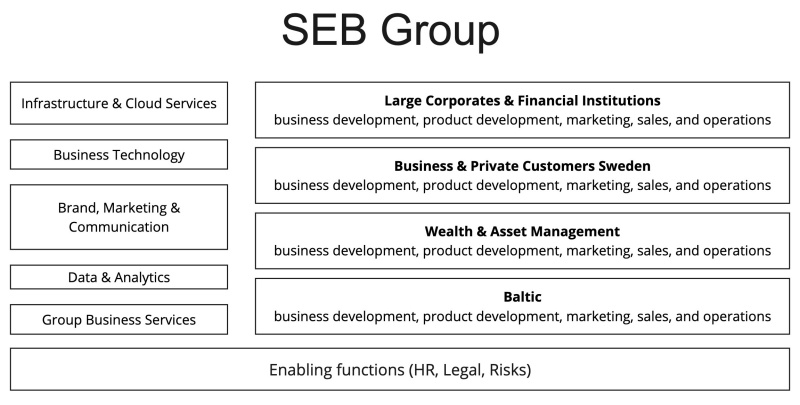
SEB Group through the Front–Middle–Back lens
Samsung. A similar logic appears in the way business lines Mobile eXperience, Visual Display and Digital Appliances are structured. For each of them there is its own front and middle: teams for business development, product management, marketing, sales and operations for their device and ecosystem category. At the same time, the back layer highlights assets shared across the entire company – semiconductors, displays, central R&D and platform capabilities. This design makes it possible to build very different product lines and customer offerings on a common technological and component base, maintaining scale and efficiency at the group level.
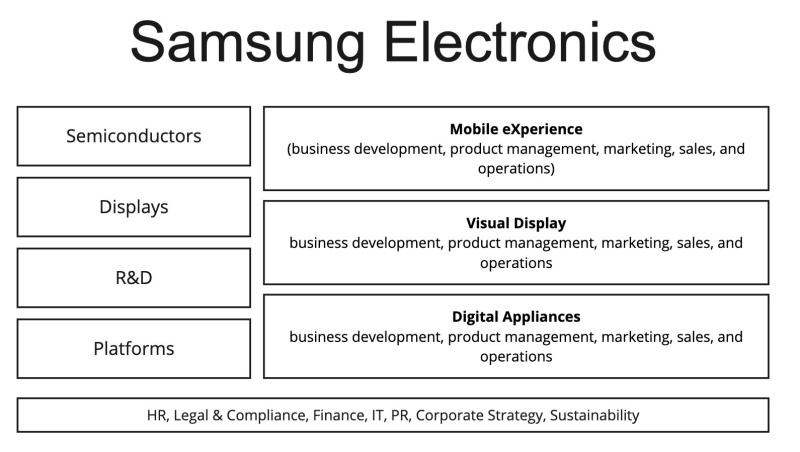
Samsung through the Front–Middle–Back lens
Option C becomes a natural choice where the boundaries between customer segments and product lines are relatively clear and cross‑purchases are rare. In such a configuration, it makes sense to “color in” the front and middle as much as possible for different segments, giving them freedom in business development and product agenda, while keeping a shared back layer as the main source of operational efficiency due to a single platform, technology and component base.
Summary: How to Use FMB Patterns
In this article, I showed Front–Middle–Back as a set of typical patterns from which companies assemble their real architecture. We looked at three basic options:
- when differentiation lives primarily in the middle with shared front and back;
- when the back has to be differentiated together with the middle;
- and when the front and middle are differentiated simultaneously while the back remains shared.
The company examples show that the choice of a particular option is determined by where exactly the company bets on being different from competitors, how customers buy its products and which platform assets make sense to centralize. It is important to use this language to consciously decide what to differentiate, what to combine and how to connect front, middle and back to your strategy.