
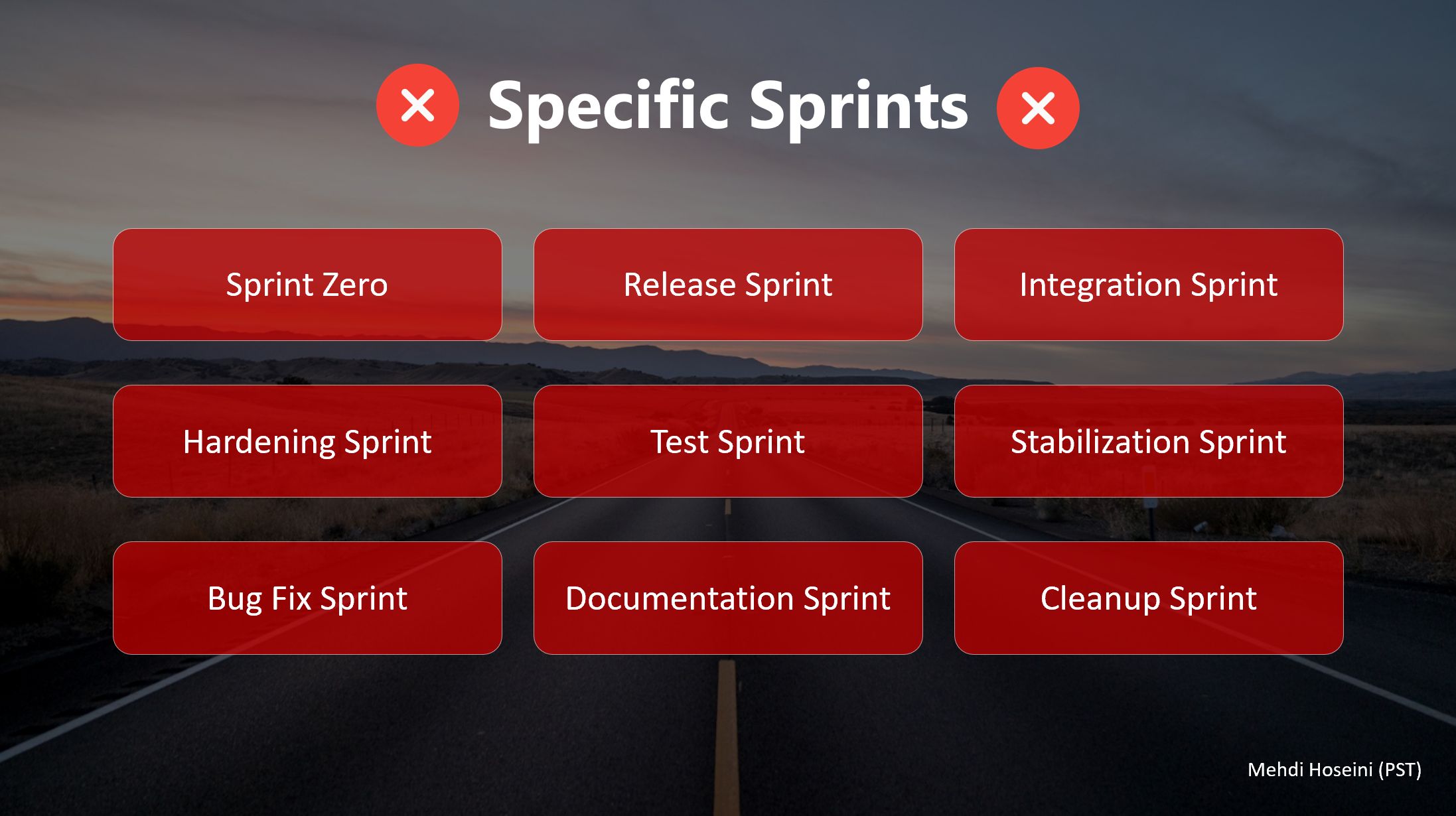
I have been in the Scrum world since 2013. Many times, I have seen teams use specific Sprints with specific names for specific purposes. But there is a problem with this approach.
Every Sprint is a learning loop, and you need to close this learning loop by creating Done, usable Increments, delivering them to stakeholders, and getting feedback. The result is a true adaptation for the next Sprint based on transparency.
Now, when you change the intention of a Sprint to a specific intention, in fact, you are missing the main purpose of the Sprint, which is real learning from stakeholders based on Done Increments.
Let’s check some of them.
Sprint Zero:
Sprint Zero in the market means you use a Sprint at the beginning of the project to prepare your environment, infrastructure, architecture, and other prerequisites to start Sprinting.
Maybe you ask what the problem is with Sprint Zero. The problem is that you have a tendency to postpone creating Done Increments, while even in the first Sprint, you should have the intention to create at least one business functionality that transfers value to the stakeholders. It is a means to close the learning loop of the Sprint.
Test Sprint:
You postpone all the test work of several Sprints to a specific Sprint in the future. In this approach, you don’t have a usable Done Increment in the regular Sprints.
Integration Sprint:
You postpone all the integration work to a specific Sprint in the future, which increases the risks.
Now, you may ask how we should name Sprints.
The answer is simple. Whatever naming you want, as long as you don’t change the main intention of the Sprint, which is learn by creating and delivering Done Increments.
-----------------------------------------------------
If you want to start your Scrum journey powerfully and learn Scrum through a high-quality training with a super bonus (a bonus that you cannot find anywhere else), attend my upcoming Professional Scrum Master (PSM) class. Click here to get more information about the class.