
Organizational capabilities are the skills, competencies, and alignment of people that create competitive advantage and define what a company must be able to do to win in the market. Companies use organizational design to develop those capabilities that will actually deliver their strategic goals: first you define the strategy, then the critical capabilities, and only after that do you design structure, roles, and connections.
What is organizational mapping?
Organizational mapping is a business‑architecture technique that links a map of organizational capabilities to the real organizational structure: business units, teams, and functions. On one layer you describe which capabilities are required to execute the strategy; on another you list the units and blocks you actually have. The mapping makes explicit which unit develops, sustains, or uses which capability.
Organizational mapping makes visible which units are truly executing the strategy, and where key risks and gaps sit. It reveals duplication and “orphan” capabilities with no clear owner, provides a basis for investment decisions and change‑impact analysis, and creates a shared language across functions around the question “which capabilities do we need, and who is accountable for them?”.
Case SecuriOne: three strategic lenses in one organization
In the SecuriOne case, a company wanted to strengthen three lenses at once: maintain a strong product‑centric focus, become more client‑centric, and improve operational efficiency. Under the new strategy they defined three groups of target organizational capabilities.
Product‑centric capabilities:
- Flexible allocation of resources across product lines.
- Adaptiveness – rapid response to market and technology changes.
- Developing cutting‑edge products.
- Deep R&D expertise.
Client‑centric capabilities:
- A single support window across the entire portfolio.
- Selling complementary products and creating bundled offerings.
- Adaptiveness – rapid customization of solutions based on client requests.
Operations‑centric capabilities:
- Common standards for work and technology.
- Avoiding duplication of development and increasing the return on the shared technology base.
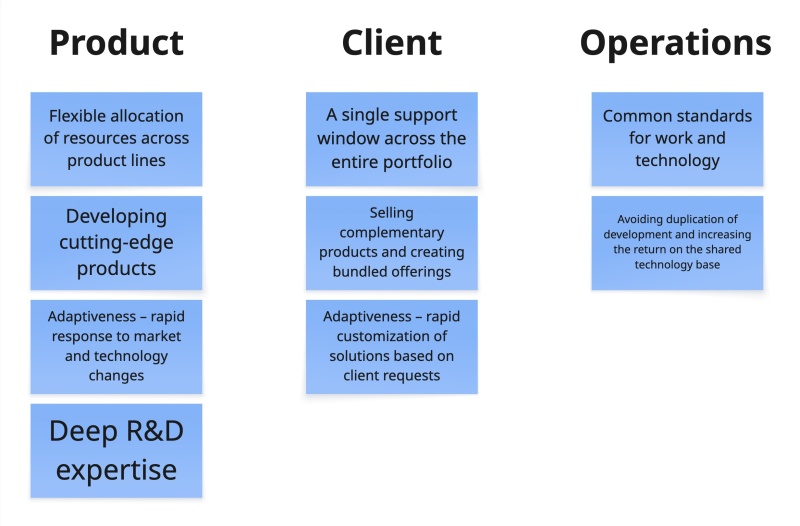
On a separate capability map these capabilities are grouped under three strategic foci — product, client, and operations — so you can see on a single page which capabilities the company is strengthening in each direction and how balanced the overall set is between product, client, and operations.
Front–Middle–Back plus organizational mapping
SecuriOne uses a Front–Middle–Back model as the structural frame for these capabilities. The Middle layer remains product‑centric: this is where product management lives and owns the creation of cutting‑edge products and the adaptiveness of solutions. The Back focuses on the shared technology base, R&D, and engineering. The Front concentrates client‑centric capabilities: a single communication window for customers, integrated sales that can cross‑sell and sell bundled solutions, plus a dedicated unit that customizes solutions for specific clients.
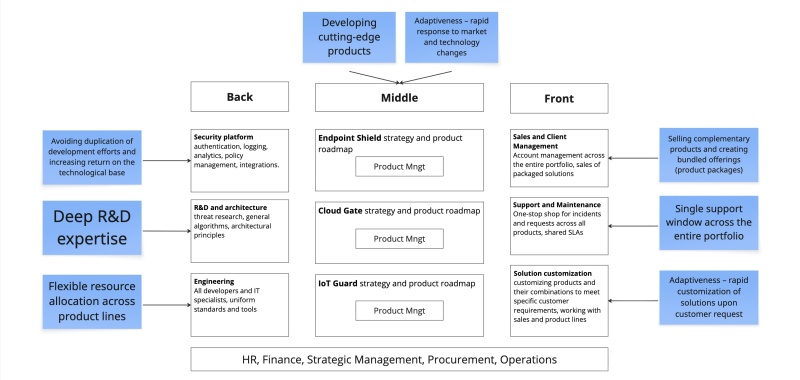
Organizational mapping laid over this Front–Middle–Back frame shows which product capabilities live in the Middle, which technology capabilities live in the Back, and which client capabilities live in the Front — and how all three layers together realize the strategy.
How to build an organizational mapping: a simple algorithm
- Define your primary strategic focus: do you want to emphasize product, client, operations, or a specific combination of them.
- Create a map of the organizational capabilities you want to develop and preserve according to your strategy; sources include analysis of the current organization, the chosen strategic focus, and typical capabilities of agile organizations.
- Draw your current structure and map capabilities onto existing business units; misalignments, duplications, and gaps in accountability will surface quickly.
- Design a target structure so that each unit has clearly assigned capabilities — this is your organizational mapping that tests and reinforces the “strategy – capabilities – structure” linkage.
Conclusion
Organizational mapping is a way not only to check, but also to design a structure in which strategic focus, organizational capabilities, and organizational design truly work as one coherent system.