
Have you ever seen a tensegrity structure? Take 58 seconds and watch this video from Steve Mould. It'll stick with you.
And if you'd rather keep reading:
Tensegrity structures are these fascinating constructions of floating rods and cables where no rod directly touches another - and yet the whole thing holds together, remarkably resilient against disturbance.
I first encountered tensegrity in a completely different field - sports science. The human body is held in constant balance by exactly this kind of structure: muscles, fascia, tendons - tension and compression working together.
The elegant part? Stability doesn't come from rigid connections. It comes from balanced tension across the entire network. Every cable is pre-tensioned. Every rod carries its part. And when you push at one spot... the tension shifts everywhere.
Not just where you pushed.
Everywhere.
That got me thinking. It reminded me of something I see all the time: organizations that resist change with everything they've got.
Organizations are tensegrity structures

When I look at organizations through this lens, I see:
- Rods (compression elements): Formal structures, processes, job descriptions, hierarchies - what's on the org chart
- Cables (tension elements): Informal networks, culture, relationships, unwritten rules - what actually holds the organization together
- Pre-tension: The permanent tension between "how it's always been" and "how it could be"
So here's the question: What happens when you intervene in this structure?
Right. The tension shifts everywhere.
Let me illustrate with a scenario most Scrum Masters know too well.
You help a team adopt new ways of working - Scrum, Kanban, AI... whatever fits. Suddenly the whole network pulls differently. Some roles lose relevance. Certain meetings become obsolete. Decision paths that worked for years don't fit anymore. The system reacts. And it reacts systemically, not locally.
That's not sabotage. That's physics.
But: In social systems, tension isn't measured in newtons. It's felt as fear. As stress. As resistance. The physics explains the how. The psychology explains the why. Understand both, and you'll get further.
What this means for you as a Scrum Master
When your change efforts hit resistance, the typical reaction is: more of the same. Another workshop. Another presentation. Another stakeholder deck. That's like pulling on a tensegrity structure and being surprised that it wobbles.
What works better? A different view of the system.
1. Map the network - not the org chart
Ask yourself: Who's maintaining the tension that's blocking you right now? Often it's not the loud one. Often it's someone quietly holding the cables. Informal influence, long-standing relationships, unspoken agreements.
One tool that helps: Causal Loop Diagrams (CLDs). The idea is simple - you draw which variables influence each other and in which direction. No boxes and titles. Arrows showing: when X increases, Y increases too - or decreases.
What becomes visible: feedback loops. Circles that amplify change. And circles that pull the system back to where it started.
Two examples you'll often find:
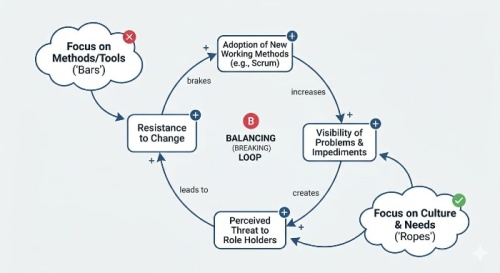
The braking loop: e.g.: New ways of working create more transparency → Problems become visible → Role holders feel threatened → Resistance increases → Initiative loses support → Less transparency.
Sounds familiar? Nobody plans this. The system does it by itself.
Here's what matters: If you push against the resistance, you increase the counter-tension. The tensegrity structure doesn't get more flexible - it cramps up. What actually helps: release the counter-tension. Don't try to convince the threatened role holders. Understand what they need for the threat to decrease.
The reinforcing loop: e.g.: The team delivers noticeably better results through more autonomy → Stakeholders experience value → Trust in the team grows → More autonomy → Better results.
This runs by itself too. Once you've kicked it off.
CLDs help you recognize recurring patterns, make unintended side effects visible, and find the leverage points where small changes can have big effects.
If you want to learn more, The Systems Thinker offers practical articles that are easy to digest.
2. Change tension - not rods
Introducing frameworks like Scrum (swapping rods) does little if the cables stay the same. Culture, trust, relationships - those are the tension elements. Invest there.
A single conversation with an informal opinion leader often achieves more than yet another all-hands meeting.
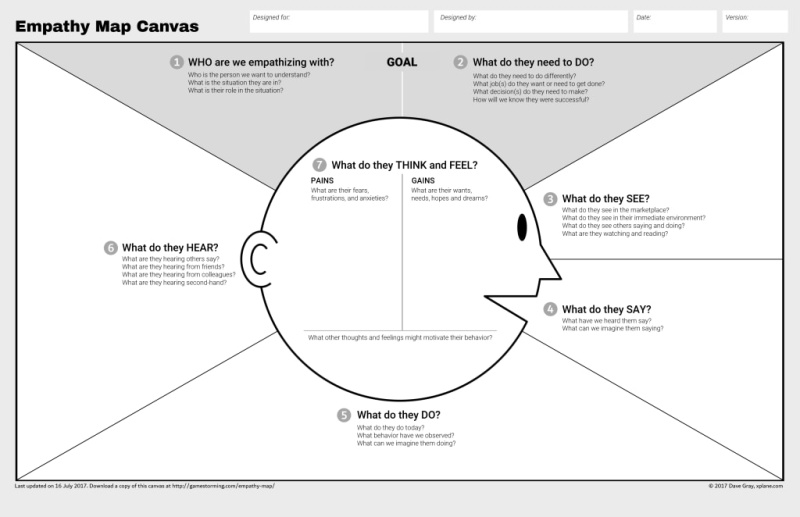
And for that conversation, you need to understand what your counterpart needs. Use an Empathy Map to "feel into" your stakeholders. You note down what they see, hear, think, feel - and what drives or blocks them. Takes ten minutes. Changes how you enter the conversation. And how you frame your "offer."
And the conversation itself? That needs a different language.
Your team members don't care about process changes or method names. They care about: What does this mean for me? Will it get easier or harder? Do I still have a job? What challenges am I facing? Will I get relief in return? Will I be heard?
So talk about that.
"We need more transparency." - Too abstract.
Better: "Two Sprints in a row, we've committed to more than we delivered. Both times, people told me afterward they'd seen it coming but didn't want to be 'the negative one.' I'd rather have an uncomfortable conversation on day one than a missed Sprint Goal on day ten. What would make it okay to say 'this is too much' - early?"
"We need better cross-team communication." - Too vague.
Better: "Last Sprint, we discovered on day eight that the API team had changed their contract. We'd built against the old spec for a week. That's five days of rework we could have avoided with a ten-minute check on day one. How can we make sure we catch these dependencies before they catch us?"
The pattern behind this comes from Nonviolent Communication: State an observation → Name the impact → Share your need → Make a request. It works because it doesn't corner the other person - it invites them.
This pattern works everywhere conversations get tricky - giving feedback, setting boundaries, clarifying expectations. It takes the edge off without losing clarity. And: it invites you to first look at yourself. Why does this matter to you? How do you notice it? What do you need?
That doesn't just create clarity for your counterpart. Mostly, it creates clarity for yourself.
3. Change the system in small steps - and observe
Tensegrity structures don't react linearly to pressure. Small changes can have big effects. Sometimes in completely unexpected places.
Two examples:
A Scrum Master changes the format of the Sprint Retrospective. Instead of sticky notes and voting, one single question: "What surprised you this Sprint?" Suddenly conversations emerge about risks and dependencies that never surfaced before. Nobody introduced a new structure. Nobody ran a training. One question shifted the tension in the system.
Or: You sharpen the quality of the Sprint Goals - and the endless scope discussions in Sprint Planning disappear. The leverage point often isn't where the pain is.
Just as an osteopath might stretch your hamstring to fix a stiff neck, your leverage point might not be where the pain is. Try changing one Sprint Retrospective question or sharpening a Sprint Goal. Observe the ripple, then adapt.
4. Talk with the system - not about it
Bring the right people together. Not to sell the change. But to make tension visible: Where's it going well? Where's the friction? What's losing relevance - and what's gaining?
When people can name this together, the tension often shifts just from that.
Here are two formats from Liberating Structures that can help:
Fishbowl: One group sits in the middle and talks - the other sits outside and listens. Then switch. Suddenly people hear things they always suspected - but that were never said openly.
What I Need From You: Each role states what they concretely need from others - and the others answer: "yes", "no", or "I can offer something different." Makes dependencies and unspoken expectations visible without anyone getting attacked.
Both formats create space for tension to surface - without turning into blame.
And one more lens that helps: Panarchy. It's a concept from ecosystem research that describes how systems move through cycles - growth, conservation, release, reorganization. Teams and organizations do the same.
Ask yourself: Where is your team right now? Are they in a rigid conservation phase - optimizing what exists, resistant to change? Or have they just been through a release - old structures broke down, things feel chaotic but open? The answer changes what kind of intervention makes sense. Pushing new ideas into a system that's locked in conservation mode creates resistance. The same ideas, introduced during reorganization, might take root easily.
Panarchy won't give you a tool for Monday's Retro. But it might stop you from pushing at the wrong moment.
The big message?
Change efforts rarely fail because of the idea.
They fail because we introduce local tools into systemic structures - and then act surprised when the system reacts.
The good news: Tensegrity structures aren't rigid. They're flexible. And once you understand how they work, you can change them. Not through force. Through understanding.
That's what sets effective Scrum Masters apart from average ones. Not knowing the "right" method. Understanding the tension in the system.
And when you look at your organization now: Where would you need to pull a little more? Where might you even need to build some pressure? And where would it help to simply let go?
Want to go deeper?
If you want to find the right leverage points in your agile organization and communicate with precision: This April there's another PSM III Bootcamp. Four weeks focused on communication for the essential levers in agile work. One question per day. At the end, the PSM III assessment from Scrum.org. Pass it, get money back. For experienced Scrum Masters only.