
Artificial Intelligence is transforming how teams do their work. AI assisted coding has taken teams by storm, every team now uses one or the coding agent like Claude or Copilot. All the work, all the changes are becoming faster, data-driven and augmented by AI.
However, with all this technological advancement and if I may call it the rat-race of creating the next AI driven product, one question is getting overlooked:
Is Psychological Safety still intact when AI enters the team?
Psychological safety, the shared belief that team can experiment, fail without fear has been an integral part of self managing Scrum Teams. In AI-driven teams, it becomes even more crucial. Without it, the very tools designed to enhance productivity can silently erode collaboration, innovation, and trust.
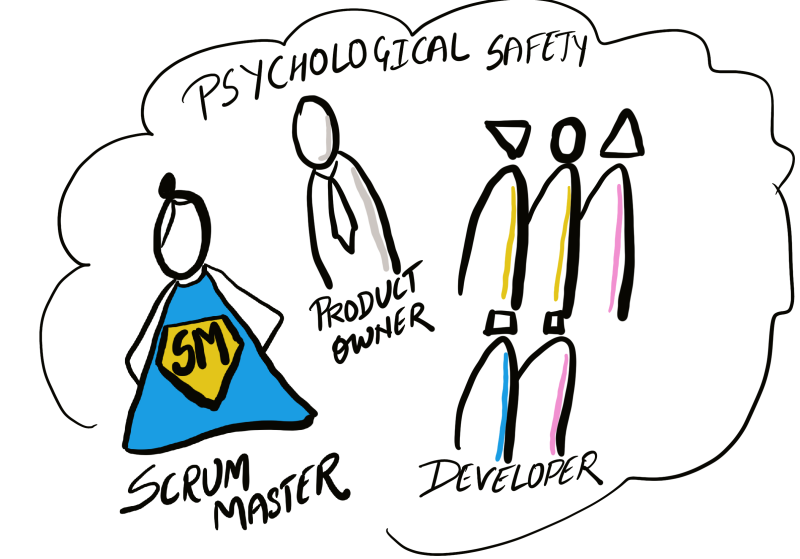
What Is Psychological Safety in Scrum?
Scrum enables the empirical approach to Product Development. It is upheld by the key tenets of Transparency, Inspection and Adaptation. Transparency requires Trust and Trust can only be established if team members feel that they operate in a psychologically safe environment.
Scrum Master is typically the custodian of creating the psychological safe environment for the team. In context of Scrum it can start with the very basics where team members find it easy to:
- Admit mistakes without fear of blame
- Challenge ideas (including those generated by AI)
- Ask for help early
- Experiment and learn rapidly
- Speak their mind without fear of repercussions
And in case of highly matured Scrum Teams it might also mean that team members:
- Hold each other accountable
- Have the courage to Say NO, even to the stakeholders and leaders
- Make decisions that can shape the future of product or organization
- Curiosity leads the way of working instead of being punished
- Vulnerability and Acceptance become common personal traits
The curious case of AI Driven Teams
AI introduces a double edged sword where there could be benefits to be achieved along with risks for psychological safety
The possibilities:
- Reducing cognitive load (e.g., drafting code, summarizing discussions)
- Providing neutral, data-driven insights
- Helping quieter team members contribute through AI-assisted communication
- Enabling faster learning and experimentation
The risks:
- Team members may worry about losing relevance
- Team members might not challenge AI results
- AI driven metrics might look like continuous survellience
- Every aspect is now about AI automation and less human interaction
- Team decisions get impacted by AI Bias and hallucinations.
The result? Teams may become quieter, less creative, and less willing to take risks.
Why Psychological Safety Matters Even More with AI
Artificial Intelligence, that is available to us in today's world is not perfect (and I doubt it will ever be; after all it is artificial, human made). We call it the Artificial Narrow Intelligence, i.e. it has been created to do one specific task and thus, AI-generated outputs can be flawed, biased, or contextually incorrect. Teams must feel safe to question and override AI decisions.
It is also imperative to understand that learning happens through experimentation; even the AI driven teams require that space to try and fail without fear. Also, when it comes to AI, as of now it doesn't have the capability to think rationally or ethically. In AI driven teams these are still the characteristics of the humans and if humans aren't allowed to express these traits then the teams will collapse.
Lastly, Scrum still will need Transparency to deliver great results. If team members do not have the right level of psychological safety and they don't raise concerns about the AI tools or its outputs then the Transparency is eroded and it will eventually impact empiricism.
Conclusion
Irrespective of whether AI drives your teams or not; Psychological Safety still remains an important aspect of self-managing teams. High performance comes from teams that have Trust, Transparency and Vulnerability as their foundation and not just tools. If there is no psychological safety then AI can lead to fear and mistrust instead of being a catalyst for innovation and experimentation.
The goal should always be to create teams that are not AI driven but that use AI as tool wisely and ethically.
P.S. If you are interested in learning more about AI driven teams or the role of Scrum Master and Product Owner in AI teams explore our courses here and here.
P.P.S If you are still navigating your ways through agile ways of working then we have some great courses for you too.