
I remember once one of my friends said a great thing about Done:
A chair is not Done until a person sits on it, saying that's comfortable.

The Done concept is so important that if we wanted to squeeze Scrum into just one sentence, it would be:
"Creating Done Increment each Sprint."
Although it is so important, still many Scrum Teams don't use it. Probably, one of the reasons is that they don't know how to create a reliable Definition of Done.
In this blog post, I want to show you how to leverage AI to create your Definition of Done or update your current one.
When you want to use AI, you need to effectively communicate your request with the AI system. A good communication guideline has the following steps:
1- Define your context:
What is the high-level concept of your product, the product name, ...
2- Teach the AI system:
Tell it on the fly what the Definition of Done is.
3- Ask for items from the main categories of the expectations:
A comprehensive Definition of Done covers 6 categories of expectations as follows:
1- Process expectations
2- Technical expectations
3- Delivery expectations
4- Industry standards & expectations
5- Organization expectations
6- Non-Functional Requirements
The result of this process is the following prompt:
--------------------------------------------------
"We are building an application for [The high-level concept of your Product]. The product name is [Your Product name].
The Definition of Done is the common shared understanding of the criteria that must be met for an Increment to be considered complete. It is the commitment of the Increment artifact to enhancing transparency and focus.
Create a Definition of Done document containing all required expectations for the [Your Product name] product.
The Definition of Done should be like a checklist, including the following main categories of expectations:
1- Process expectations
2- Technical expectations
3- Delivery expectations
4- Industry standards & expectations
5- Organization expectations
6- Non-Functional Requirements"
--------------------------------------------------
Copy this prompt, paste it into an AI system like ChatGPT, fill in the brackets with the specific data of your product, and enjoy the result.
-------------------------------------------------------------------
Do you plan to become a Scrum Master?
Then, you don't want to miss my Job Switch PSM Package.
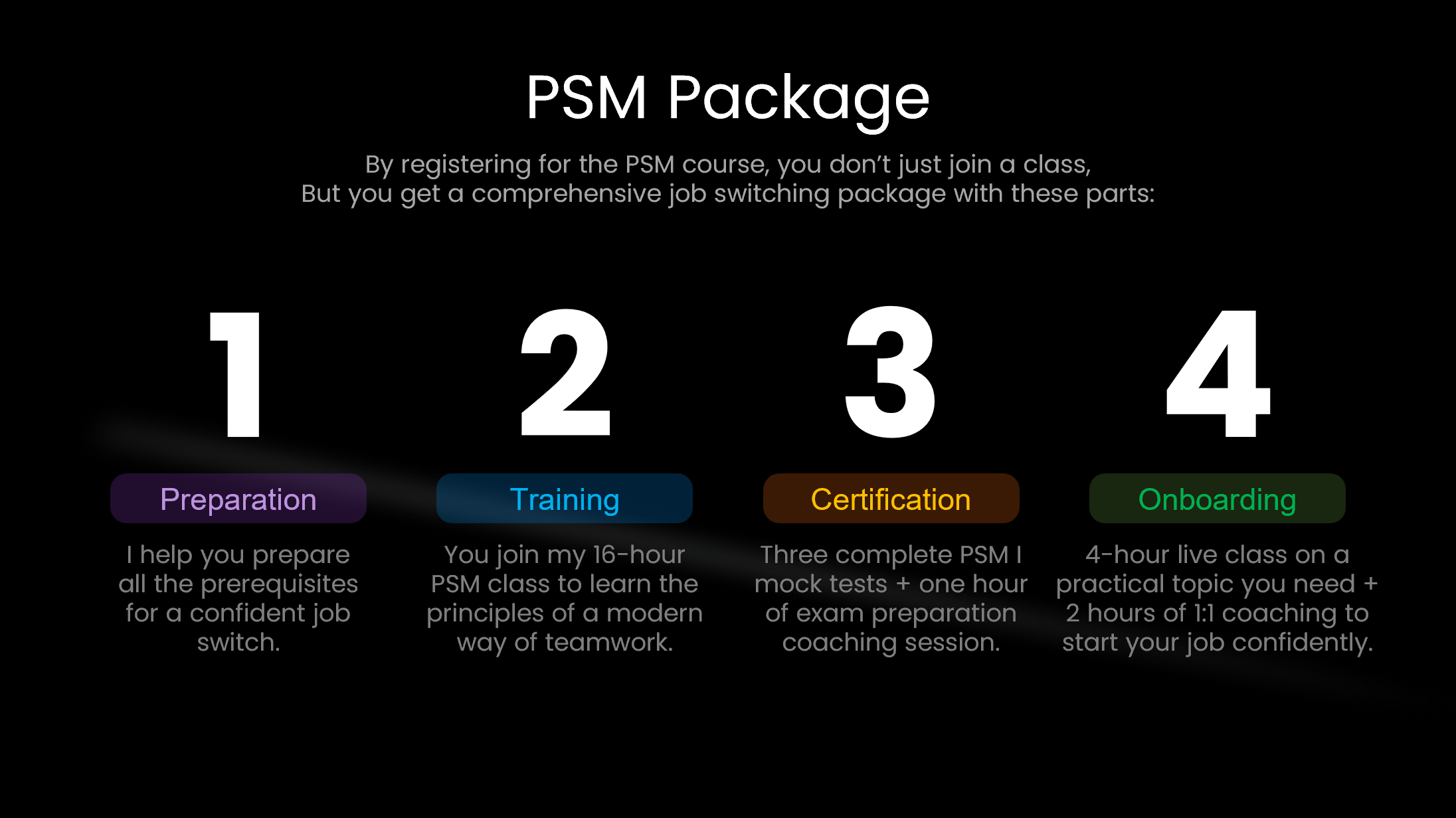
I am the only Professional Scrum Trainer (PST) in Europe who exclusively serves IT Professionals seeking an internal job switch within their current company to become a Scrum Master or start using Scrum.
Instead of just giving you a training and leaving, I walk with you step by step throughout your entire career transition. This includes four steps of job switch preparation, PSM training class, earning your PSM I certification, and successful onboarding into your new position.
By registering for my Professional Scrum Master (PSM) class, you will get my Job Switch PSM Package. Click here to get more information about the class and package.