
Which steps should a football team take to win the World Cup?
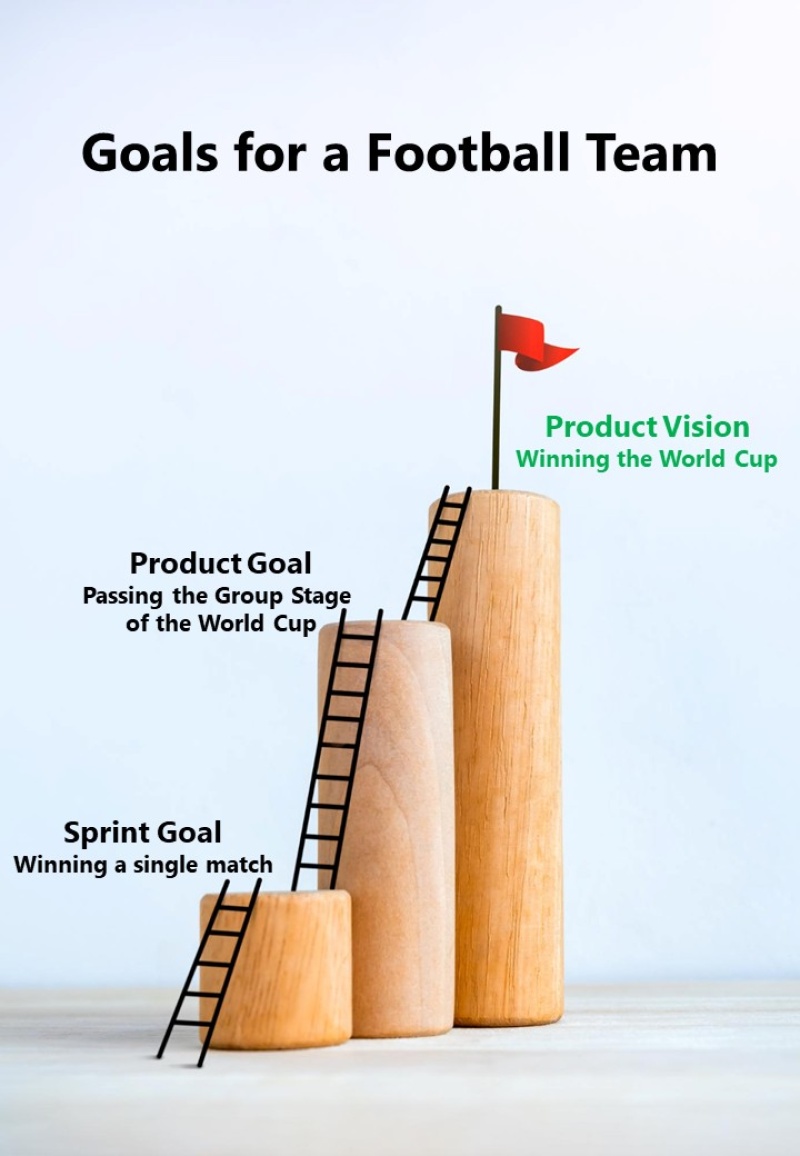
1- Regional Qualifiers: A football team should first win in the continental qualification tournaments, like in Europe, Asia, ...
2- Group Stage of the World Cup: Then they should pass this step, where each team plays 3 matches, and so on ...
3- Final Match: Ultimately, they go for the final match to win the World Cup.
In the Scrum Guide, it is said that the Product Goal is the future state of the product. But, I prefer to use it as the mid-term goals and use the Product Vision as the long-term goal. Then they create a chain of goals, each one supports the next one.
Sprint Goal: Short-term goal
Product Goal: Mid-term goal
Product Vision: Long-term goal
With the football analogy:
Sprint Goal: Winning a single match
Product Goals: Regional Qualifiers, Group Stage of the World Cup, ...
Product Vision: Winning the World Cup
In this blog post, I want to show you how to leverage AI to create Product Goals.
When you want to use AI, you need to effectively communicate your request with the AI system. A good communication guideline has the following steps:
1- Define your high-level goal (Product Vision):
Your Product Goal is not in a vacuum. It is part of a higher level of goal. I mean Product Vision. They should be aligned. It means your Product Goal should support achieving your Product Vision. They are like a chain.
2- Define your context:
What is the primary function of your product? What is your Product Vision? What is the context of your product?
3- Teach the AI system:
Give a guideline to your AI system on how to create the Product Goal.
Use the SMART model as follows:
Specific: The goal should be clear and specific, avoiding any ambiguity about what is to be achieved.
Measurable: The goal should have criteria for measuring progress and success, so you can track your achievements.
Achievable: The goal should be realistic and attainable.
Relevant: The goal should matter to you and your stakeholders and align with other relevant objectives, ensuring it is worthwhile.
Time-bound: The goal should have a clearly defined deadline to create a sense of urgency and focus.
The result of this process is the following prompt:
--------------------------------------------------
We are building [Your Product]. The Product Vision is [Your Product Vision].
[Give it a little bit of context by explaining the high-level concept of your product and how it is going to create value].
We use Product Goals as the mid-term goals. So, break down the Product Vision into several smaller mid-term goals and create the first Product Goal (mid-term goal) within the SMART model boundaries as follows:
Specific: The goal should be clear and specific, avoiding any ambiguity about what is to be achieved.
Measurable: The goal should have criteria for measuring progress and success, so you can track your achievements.
Achievable: The goal should be realistic and attainable.
Relevant: The goal should matter to you and your stakeholders and align with other relevant objectives, ensuring it is worthwhile.
Time-bound: The goal should have a clearly defined deadline to create a sense of urgency and focus.
--------------------------------------------------
Copy this prompt, paste it into an AI system like ChatGPT, fill in the brackets with the specific data of your product, and use the result as the draft version of your Product Goal. I say draft, because you can tweak it into a better version with your intuition.
This is a sample prompt for a double-sided learning platform product:
We are building a double-sided learning platform. The Product Vision is to become the biggest learning platform worldwide.
The first side of the platform is for learners helping them to get quality learning services.
Another side is for trainers to build their training business and reach a highly segmented audience of active learners.
We use Product Goals as the mid-term goals. So, break down the Product Vision into several smaller mid-term goals and create the first Product Goal (mid-term goal) within the SMART model boundaries as follows:
Specific: The goal should be clear and specific, avoiding any ambiguity about what is to be achieved.
Measurable: The goal should have criteria for measuring progress and success, so you can track your achievements.
Achievable: The goal should be realistic and attainable.
Relevant: The goal should matter to you and your stakeholders and align with other relevant objectives, ensuring it is worthwhile.
Time-bound: The goal should have a clearly defined deadline to create a sense of urgency and focus.
--------------------------------------------------
Copy this prompt, paste it into an AI system like ChatGPT, and enjoy the result.
-------------------------------------------------------------------
Do you plan to become a Scrum Master?
Then, you don't want to miss my Job Switch PSM Package.
I am the only Professional Scrum Trainer (PST) in Europe who exclusively serves IT Professionals seeking an internal job switch within their current company to become a Scrum Master or start using Scrum.
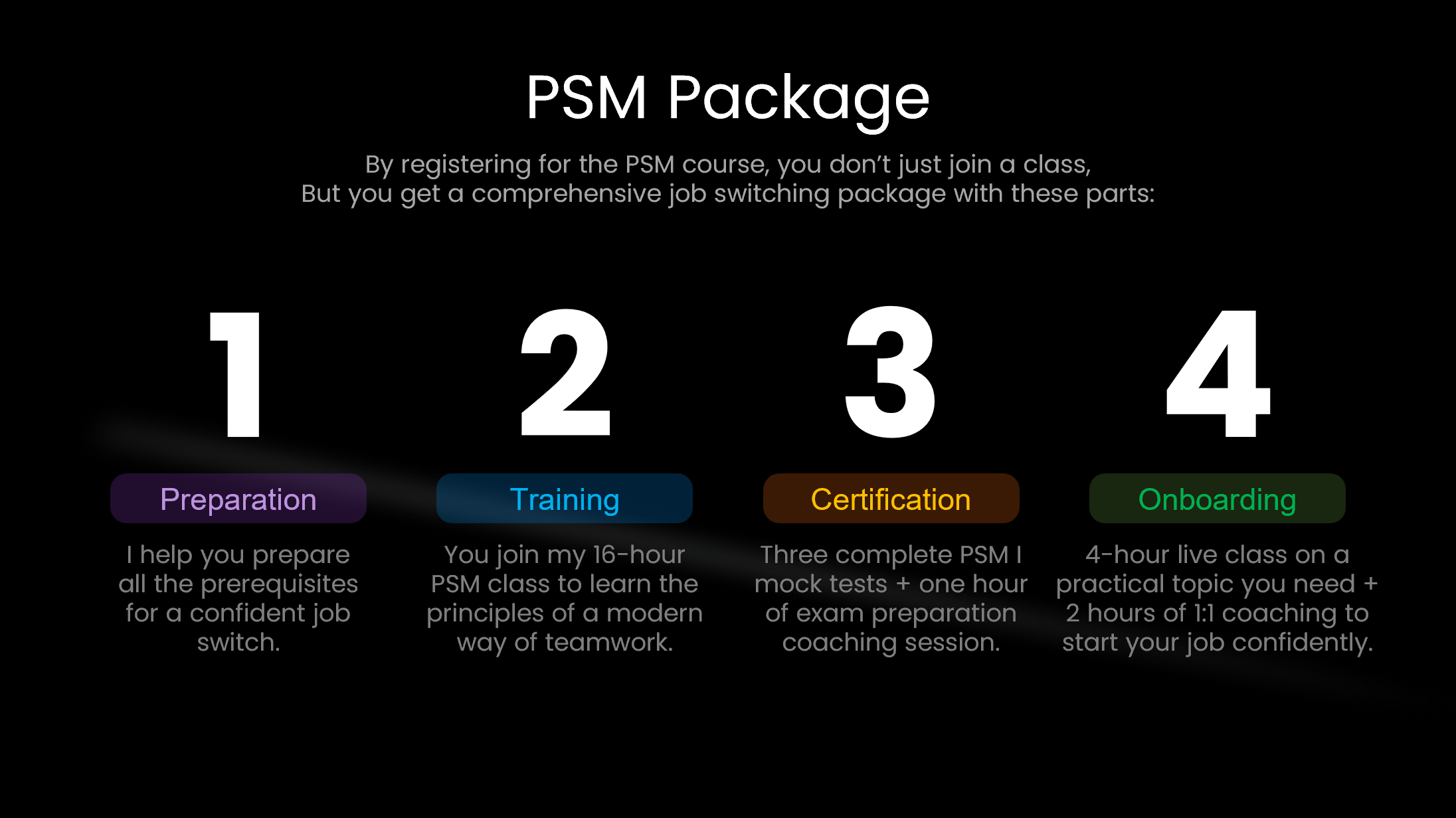
Instead of just giving you a training and leaving, I walk with you step by step throughout your entire career transition. This includes four steps of job switch preparation, PSM training class, earning your PSM I certification, and successful onboarding into your new position.
By registering for my Professional Scrum Master (PSM) class, you will get my Job Switch PSM Package. Click here to get more information about the class and package.