

You can get your book on Amazon.com here.
It's The System, Stupid.
Leaders love speed. I do too. But I’ve learned to distrust the sentence that usually follows:
“If we can just make our teams more efficient…”
That sentence is a trap. Not because efficiency is bad. But it quietly assumes that the bottleneck is within the teams. And I have learned as a Scrum Master, that in most organizations, it 's not a team problem.
Teams are rarely the reason things move slowly. The system is.
People are usually doing what the organization makes them do: navigate dependencies, translate strategy into something deliverable, survive governance, keep stakeholders calm, hit local targets, and absorb the chaos that the org chart politely ignores. And when performance disappoints, we are asked to fix something “at the team level”: new ways of working, new rituals, new tools, new coaching, new KPIs.
This is the starting point of 10X ORG:
We don't need culture posters. We don't need another transformation program. We need thoughtful org design.
The Uncomfortable Idea Behind the Book
Most leaders try to improve performance by changing what people do. But performance is largely shaped by what the organization makes possible.
If your structure forces handovers, you will get handovers—no matter how talented your people are. If decisions require negotiation across five silos, you will get delay—no matter how much ownership you preach. If targets are local, people will optimize locally—no matter how many times you say “end-to-end value.”
This sounds obvious. And yet most organizations behave as if it isn’t true.
Organizations don’t “have” performance. They produce it—by design.
Once you take that seriously, you stop treating every symptom as a skills problem or a mindset problem. You start looking at the conditions that keep producing the same friction.
What 10X ORG Feels Like to Read
This book doesn't start with a model and then try to convince you to use it. It’s written the way change actually feels: messy, political, human, and full of trade-offs.
You follow leaders inside a company where pressure is rising—expectations, deadlines, metrics—and where “doing more” is no longer a strategy. The story isn’t there to entertain you with fiction. It’s there to make patterns visible. Recognizable. Almost uncomfortable.
Then the book pauses. Not to preach, but to explain what just happened in structural terms. The book explains why the friction manifested itself. Why the usual fixes make it worse. Which levers actually exist, and which ones are just management theater.
You can read it straight through for momentum. Or you can treat it like a field guide: story for recognition, theory for application. Either way, it’s designed to support thinking and action—not just highlight underlines.
The Patterns the Book Puts on the Table
There are a few patterns that keep repeating across industries.
One is the reflex we call the “local optimization." Something breaks—quality drops, a team is late, customers complain—and the organization responds locally. Another check. Another approval. Another coordinator. Another role to “own the problem.” It usually works in the short term, because it creates the illusion of control. And then, slowly, the whole system gets heavier. More waiting, more translation, more coordination. Fast solutions create slow throughput in the long run.
Another pattern is organizational aging. Startups can be chaotic, but they move. Big organizations can be stable, but they often stiffen. Over time, companies accumulate structure meant to reduce risk: specialization, handovers, budget rituals, portfolio committees, planning cycles that outlive their usefulness. It’s understandable. It’s also how organizations quietly lose their ability to adapt. Not because people stopped caring. Because the system stopped learning.
And then there’s the transformation treadmill. You’ve seen it. New labels. New org charts. New templates. A town hall full of optimism. Six months later: the same friction, wearing a different name.
Why? Most transformations try to change behavior without changing the system that shapes behavior. So people comply, but the organization doesn’t actually move.
10X ORG is written for people who are tired of that treadmill—and who suspect, correctly, that the real work sits deeper than “adoption,” and are looking for ways to fix the problems systemically.
What you get out of it
If you want a book that gives you a neat recipe, this isn’t it.
What you get instead is you learn to see.
You learn to spot when a performance problem is actually a decision-rights problem. When “alignment” is a substitute for clarity. When planning has become a ritual instead of a learning loop. When teams are being asked to deliver end-to-end outcomes while being managed as if they only own a fragment.
You also get language for conversations leaders often avoid because they’re awkward: incentives, governance, structure, ownership, targets. These are not viewed as abstract topics, but rather as practical levers that shape day-to-day reality.
Why This Matters Now
We’re in an era of rising expectations: Faster markets. Faster feedback. More pressure.
Many organizations respond to pressure by getting colder: more measurement, more control, more standardization, more reporting. And, replacing people with AI agents...
10X ORG makes a different move. It treats performance as a design problem first. It asks what kind of organization you’re building—and what kind of behavior that organization is inevitably producing.
If you’ve ever said, “We have good people, but the organization makes it hard,” you already understand the premise.
This book just gives you the lens—and the courage—to stop blaming people for a system they didn’t design.
What's in the Book
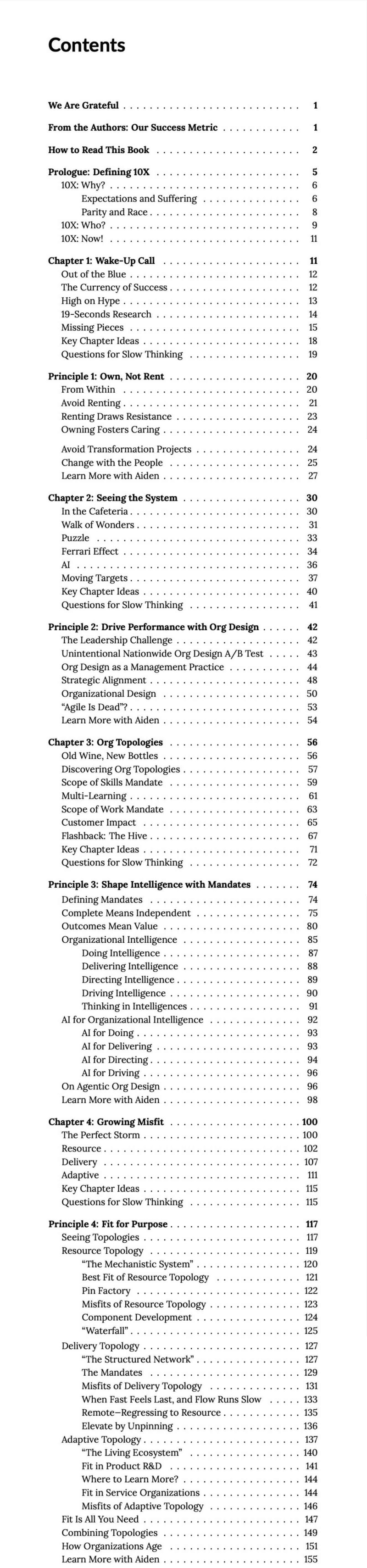

Read other blogs on Scrum.org on this subject
First Fix Your Org Design, Then Adopt AI.
Strategy + Org Design = Performance.
From Scrum to Org Design: Honesty as a Capability.
From Scaling Scrum to Designing 10X Performance
Get the Book on Amazon
You can get your book on Amazon.com here.
Dave West on the Org Topologies Approach
“Org Topologies provides a practical approach to evaluating and improving your organization. In this book, Alexey and Roland describe not only a robust strategy for organizational redesign but also introduce a simple way to get started, which is often the hardest step. You might be surprised how disconnected your organization's structure is from what you are trying to achieve with it. In this book, Alexey and Roland describe a practical approach to organizational redesign, offering a blueprint for success.”
— Dave West

Alexey, Craig & Roland